
Heaven on Earth. That’s what the Chinese call Hangzhou, and rightly so! Just under an hour away from Shanghai by train, Hangzhou is a stunning city with so much to see and do. Yet, it’s often overlooked or visited only on a day trip from Shanghai. This has to change.

Like so many places in China, Hangzhou is a vibrant mix of ancient, present and future. The city is one of China’s seven ancient capitals, with a history that goes back thousands of years. As the capital of the Southern Song Dynasty, Hangzhou prospered and grew into one of the largest and most prosperous cities in the world.
Visitors to Hangzhou are in for a treat, as the city hosts marvellous cultural and natural sights. Of all the things to do in Hangzhou, the serene UNESCO West Lake is the most famous and often the sole reason to visit.

But there is so much more to Hangzhou than the lake and the equally stunning gardens surrounding it. After spending three days in Hangzhou, we must agree that Hangzhou is heaven on earth. We just loved Hangzhou, and we’re sure that you’ll love it too.
Continue reading, and we’ll show you the best things to do in Hangzhou, where to stay, where to eat (and what to order), and our 3-day itinerary.

Please note: This post may contain affiliate links. This means I may earn a commission if you make a purchase by clicking a link (at no extra cost to you). As an Amazon Associate, I earn from qualifying purchases. Learn more.
Quick Guide to Hangzhou
Visited: December
Suggested time: 3-4 days
Where to Stay: Haitang Yishhu or the Ji Hotel Nanshan Road
Famous for: West Lake, Longjing green tea, Beggar’s Chicken
Transportation: Hangzhou Xiaoshan International Airport, high-speed rail
Tip: Riding a share bike along the lakeshore is much better than sitting in a taxi.
Unique experience: A sampan ride through the Xixi wetlands
Where is Hangzhou in China?

Hangzhou is located in the southern Yangtze River delta and is the capital city of Zhejiang province. Shanghai Hongqiao station is just under an hour away by bullet train. International airlines such as Qatar Airways, Singapore Airlines and KLM fly to Hangzhou Xiaoshan International Airport.
The city has a subtropical climate with hot and humid summers and cool winters. Autumn and spring are supposed to be the best times to visit. We visited in December, though and thought it was just grand. Visiting over Christmas is perfect if you want to avoid the crowds, as everyone will be in school or at work.
How to Get to Hangzhou from Shanghai or Suzhou
Hangzhou is less than an hour away by bullet train from Hongqiao Station in Shanghai. There is a train every 10 minutes or so (incredible, I know). Trains are super modern, clean and FAST. Book your train tickets online, and just show up with your e-ticket and passport to catch your train. Tickets cost about RMB 70.
To get from Hangzhou to Suzhou by train, you will travel back to Shanghai and then continue to Suzhou. You won’t have to transfer, though, and the journey should take less than 2 hours. Tickets cost about RMB 100 and run every 20 minutes or so.
Reasons to Visit Hangzhou

Hangzhou is one of the most beautiful cities in China and certainly one of the most pleasant. With a history of more than 2,000 years, Hangzhou is not only beautiful but also boasts incredible cultural and historic sights to visit. In fact, it is home to two UNESCO World Heritage Sites (West Lake and the Grand Canal).
When Marco Polo visited Hangzhou in the late 13th century, he proclaimed Hangzhou “beyond dispute the finest and the noblest in the world.” According to a Chinese proverb, “Above is heaven and below is SuHang (Suzhou and Hangzhou).
Today, the beauty of Hangzhou remains, and it’s easy to see why the Chinese can claim to have a piece of heaven here on Earth. The beauty of West Lake alone is a good enough reason to visit Hangzhou.
Being one of China’s wealthiest cities, Hangzhou’s sights are all kept in excellent condition. The city is clean, safe, and has a world-class infrastructure.
Lakeside Hangzhou, with its ancient pagodas, temples, monasteries, tea plantations, Chinese gardens, neon lights, and delicious food, is as Chinese and vibrant as Beijing or Shanghai but much more laid-back.
It is the perfect introduction to China before moving on to the big and busy megacities. If you’re looking to ease into China, make Hangzhou your first stop. For us, the beauty of Hangzhou lies in its lush greenery, making it easy to forget that you’re in a city with more than 10 million people.
Where to Stay in Hangzhou


As to be expected of a world-class city with a population of over 10 million, Hangzhou offers accommodations to suit every budget and taste. For casual visitors like you and me, the best place to stay in Hangzhou would be as near to West Lake as possible.
Now, that doesn’t make it any easier, as there are thousands of hotels and guesthouses around West Lake. At first, we considered the Ji Hotel, but then we found another place that we liked more. When we got to Hangzhou, we walked past the Ji Hotel, and it looked like a nice hotel in a great location.
However, we chose to stay on the opposite side of West Lake, as we thought it might be quieter and more relaxing. So, let’s tell you about the place where we stayed in Hangzhou.
We stayed at the Haitang Yishu Hostel, located on a quiet street in a whole neighbourhood full of guesthouses and boutique hotels. There is nothing hostel about the Haitang Yishu, though. Boutique guesthouse might be a more accurate description.
Our large room had a queen-sized bed, a bathroom with a bathtub and shower, and a separate toilet. Breakfast is not included, but there are many cute cafes and restaurants scattered between the guesthouses. We had steamed dumplings for breakfast from the breakfast joint just across the street.
We liked how the area is green and lush. Picture bamboo forests, manicured gardens and forests. If you’re looking for a quiet place near West Lake, such as the Botanical Garden, Dragon Well tea plantation, and Lingyin Temple, definitely consider staying here.
Things to Do in Hangzhou

Give yourself at least two full days in Hangzhou. Anything less than that will be an insult to Hangzhou’s beauty and laid-back charm.
Hangzhou proudly boasts the largest bike-sharing scheme in the world. With at least 175,000 bikes, you are never too far away from a bike. Cycling between sights is the most enjoyable way to see Hangzhou.
All you need to do is scan the QR code using Alipay, and you’re ready to roll. Alipay is an unmissable app when travelling in China, so do yourself a favour and set it up before you come. Read here how to install and use Alipay as a foreigner.
We really liked how most of the things to do in Hangzhou were free, and we only had to pay entrance fees to the Lingyin Temple complex.
While we visited all the places we mentioned in this blog on our own using a combination of bikes and Didi (Chinese Uber), it can be difficult if you don’t speak a little Chinese. After taking Mandarin lessons for more than two years, Jin’s Chinese is good enough for us to do it ourselves.
If you don’t speak Chinese but still want to experience the best that China has to offer, taking an organised tour will be much more relaxing and worthwhile. Or even better, we think (since we like to do things our way), is to get a translator who will take you where and when you want to. Jack Hangzhou is your man if you’re looking for a fixer in Hangzhou.
1. Admire the beauty of West Lake


The serene West Lake is the most famous landmark in Hangzhou. No words or photos can really capture the beauty of it.
Beauty aside, West Lake is a UNESCO cultural heritage site for the influence it has had on garden design in China, Korea and Japan. West Lake is also believed to encapsulate the ideal relationship between man and nature.
The beauty of West Lake has inspired artists, poets and lovers for centuries. The Chinese believe that certain spots of West Lake are best appreciated for their beauty during a specific time of day or season. They are called the Ten Scenes of West Lake. While being very important cultural aspects for the Chinese, for us foreign visitors, they are just pretty to look at.


The Ten Scenes of West Lake are:
- Crooked Yard and Lotus Pool in Summer
- Spring Dawn at Su Causeway
- Moon over the Peaceful Lake in Autumn
- Melting Snow on Broken Bridge
- Listening to Orioles Singing in the Willows
- Fish Viewing at the Flower Pond
- Sunset over Leifeng Pagoda
- Twin Peaks Piercing the Clouds
- Evening Bell Ringing at Nanping Mountain
- Three Pools Mirroring the Moon
We rode a bike to the Xiling Seal Society, then walked to the Crooked Courtyard before connecting to Su Causeway. The narrow Su Causeway, flanked by the lake on both sides, is 2.8 km long and makes for an excellent stroll surrounded by the beauty of West Lake.
Along the way, you’ll cross six arched stone bridges with poetic names such as Crossing Rainbow Bridge or Ripples Locking Waves Bridge. By the time you reach Leifeng Pagoda on the opposite side of Su Causeway, you’re most likely to be in a Zen state of mind.
Entrance Fee: Free
2. Go Green at Longjing (Dragon Well) Tea Plantation


A 20-minute taxi ride from West Lake will take you to the village of Longjing (龙井). Beautiful Longjing is home to the Longjing green tea plantation (also called Dragon Well green tea), which is the most famous green tea in China. Longjing has been producing China’s finest green tea for over 1,200 years,
Longjing is incredibly picturesque and should definitely not be missed. Plan to spend at least half a day here, walking between the tea bushes and tasting tea at one of the many tea houses. Of course, you should also drink the Longjin green tea while you’re here.
While you might be tempted to immediately follow the sign saying Dragon Well – DON’T. Ignore that sign for now and continue walking straight down the road. This will take you to the Nine Creeks, which is really beautiful.
We walked down this road, crossing small creeks along the way, and the scenery just kept on getting better and better. You will be swimming in a sea of green, with tea bushes tumbling down the hills from every direction.
You could hike across the mountains or take the same road you came on to return to Longjing village. Back in the village, follow the sign to the Dragon Well for more great views. We think, though, that the scenery along the Nine Creeks is much, much better. See both and decide for yourself.
Longjin Village itself is actually very nice. It was definitely not tacky or as touristy as we expected. The ladies offering tea are friendly but not pushy. Come in winter, and you’ll see hundreds of ducks hanging outside curing, often on the same washing line as the laundry.
The fantastic Green Tea restaurant, halfway between West Lake and Longjing, should definitely not be missed. It was our favourite restaurant in Hangzhou. Stop here for dinner or lunch before heading back to Hangzhou.
Entrance Fee: Free
3. Glide Through the Xixi Wetlands on a Sampan


The Xixi Wetland Park is yet another beautiful place to visit in Hangzhou. The Xixi wetlands are worth a visit not only for their natural beauty but also because you’ll find ancient villages scattered between the waterways.
The wetland has been inhabited for 1,800 years, and it’s in these villages that two of China’s most important cultural traditions were born: Dragon boats and South China Operas.
The absolute best way to see the Xixi wetlands is from a sampan, a traditional Chinese, flat-bottomed, wooden boat. Your boatman will row you along the waterways and offer you some of Hangzhou’s famous Longjing green tea. We can’t think of a better way to spend a few hours than quietly gliding along the waterways, surrounded by nature and quaint villages, while sipping on China’s best green tea.
We got a DiDi to the North Gate 西溪国家湿地公园 (北门). From the North Gate, it’s a nice 30-minute walk to reach Shentankou village, where you can get a sampan (follow the signs to Boat Dock). Hand-paddled sampans go for RMB 100 per hour.
Entrance Fee: RMB 80
4. Walk Over the Gongchen Bridge & the Grand Canal


Everyone knows the Great Wall of China, but have you heard of China’s Grand Canal?
The Grand Canal is the world’s longest man-made waterway, stretching 1776 km between Beijing and Hangzhou. What makes this feat of engineering even more incredible is the fact that it was constructed nearly 2,000 years ago! In fact, the earliest traces of the Grand Canal date back to the 5th century BC.
The entire length of the canal, which connects the Yellow River with the Yangtze River, has been declared a UNESCO World Heritage Site.
The best place to see the Grand Canal is at the Gongchen Bridge (大运河拱宸桥). This three-arched stone bridge, 92 meters long and 16 meters high, dates back to the Ming dynasty and also marks the end of the Grand Canal.
The Gongchen Bridge is beautifully lit up at night, so come here before sunset and watch the never-ending line of barges ply up and down the canal.

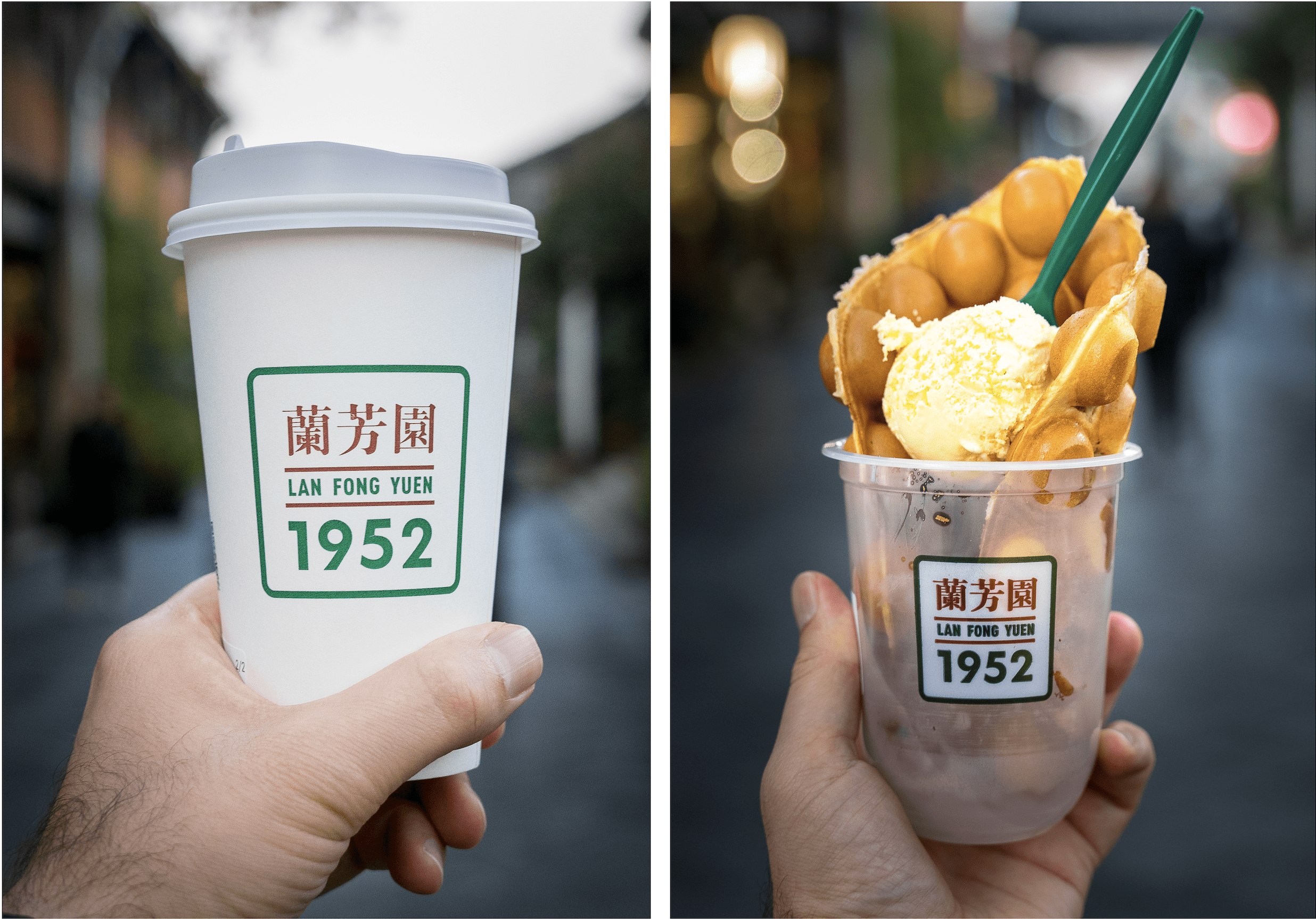
Cross the bridge on foot, and you’ll enter the very charming Qiaoxi History Culture Street. Most of the old houses have been turned into little art galleries, restaurants, cafes or museums without it being tacky.
We were over the moon when we spotted Lan Fong Yuen. If you’ve been to Hong Kong, you’ll probably know how good the milk tea from this tiny teahouse in Soho is. If you haven’t been, order yourself a sweet milk tea, watch the barges slip away underneath the Gongchen bridge…and put Hong Kong on your to-do list.
Entrance: Free
5. Take Your Soul on a Retreat to Lingyin Temple


Lingyin Temple, also known as the Temple of the Soul’s Retreat, is one of China’s largest and wealthiest Buddhist temples. At the entrance, grab a free pack of incense sticks and light them with everyone else at the sacred pot for good fortune.
The temple complex consists of several enormous halls, each containing equally enormous statues of gods and deities. The main hall houses a 19-meter-tall statue of Sakyamuni sitting on a 10-meter-tall lotus flower. In another hall, you’ll find hundreds of bronze statues depicting weird and wonderful Arhats (Buddhist disciples).
We particularly liked the nice temple gardens and the yellow-black-green colour palette of the temple.
Lingyin Temple is about 4 km from West Lake, and a DiDi or taxi should cost about RMB 15.
To enter Lingyin Temple, you will first need to pay 45 RMB to enter the Lingyin Scenic Area. Then, once you reach Lingyin Temple, you will need to buy an entrance ticket to the temple, which costs 30 RMB.
For some reason bureaucracy, you can’t buy both tickets at the same time and place. Also, remember to bring your passport along. Like many other places in China, you are required to show your passport before you can buy an entrance ticket.
Entrance Fee: 45 RMB to enter the area (you can buy it in advance here) + RMB 30 for the temple that you buy onsite.
7. Spot the fat laughing Buddha of Fei Lai Feng


Just before reaching Lingyin Temple, you’ll get to the mountain of Fei Lai Feng (飞来峰). Translated as Peak Flown From Afar, legend has it that Fei Lai Feng flew all the way from India and landed here in Hangzhou.
Legend also has it that before landing here in Hangzhou, the mountain went on a rampage and destroyed hundreds of villages while flying around.
Carved into this mountain that flew all the way from India are hundreds of Buddhas—big and small. These Buddhas were carved into the mountain to help it calm down and stop it from destroying villages again. The most famous of these Buddhas is the fat, laughing Buddha.
Why is the Laughing Buddha so fat? According to legend, the Laughing Buddha swallows all the troubles in the world and keeps them in his round belly.
Entrance to the Lingyin Scenic Area is 45 RMB. This allows access to Fei Lai Feng and some minor monasteries further away. It does not include entrance to Lingyin Temple.
Entrance Fee: RMB 45
8. Find the Best Night View of West Lake


The stunning West Lake is equally stunning at night. After the sun has set, the pagodas, bridges, pavilions and islands light up, and West Lake completely changes character. A stroll along the shore at night will not only be idyllic and romantic but is also the perfect after-dinner activity to walk off all that Dongpo pork!
Particularly scenic is the Jixianting pavilion (集贤亭), which is one of Hangzhou’s iconic scenes. The small pavilion almost seems to be floating on the lake and, with the mountains in the background, is one of the most photogenic places along the lake.
This area has many cool lakeside cafes and restaurants, and it is also popular with Chinese singing or dancing at night.
If you can’t make it to Leifeng Pagoda for sunset (One of the famous Ten Scenes of West Lake), then after dark is just as good. The five-story-tall, eight-sided pagoda is beautifully lit up at night. The best spot to admire the view and take pictures is from the Shuangtou Bridge (双投桥). From behind the Shuangtou Bridge, you’ll see the low bridge zig-zagging towards a small pavilion, with the Leifeng Pagoda standing behind it.
If you’re in Hangzhou during the summer, you should definitely go and see the highly acclaimed Enduring Memory of Hangzhou Show (from RMB 360) that takes place every night. The 1h 15m show is grand and magical on a scale only China can pull off. Everyone raves about it.
9. Make Your Mark at the Xiling Seal Art Society


Dating back to the Ming and Qing dynasties, the Xiling Seal Art Society (西泠印社) is dedicated to the research and art of traditional Chinese calligraphy. This society is recognised on UNESCO’s List of the Intangible Cultural Heritage of Humanity. Before stepping through the moon gate entrance, look over across the lake to see the Moon over the Peaceful Lake in Autumn scene.
Once inside, a tranquil garden of pebbled paths, bonsais, rockeries, ponds and traditional Chinese buildings will welcome you. Displayed throughout the complex of buildings are wonderful examples of calligraphy and stamp designs.
One stamp describes how the carver had spent his day using only four characters! The art of creating the perfect stamp is to use every line to its maximum potential so that it can express an entire culture’s ideas and psyche.


Stone seals are still used today throughout Asia instead of signatures on official documents and correspondence. For the ultimate souvenir, get your own seal made by a master carver.
A small series of steps behind the main building leads up to the carving workshop. There are countless types and shapes of stones to choose from, and the master engraver will, of course, capture you in the design.
The Xiling Seal Art Society is located on the peaceful, pedestrian-only Gushan Hill. From here, it’s a lovely walk to Su Causeway.
Entrance: Free
Also read:
➜ 10 of the Best Books to Read Before Travelling to China
10. Eat Zhejiang Cuisine

As the capital city of Zhejiang province, Hangzhou is a great place to gorge on Zhejiang, or simply Zhe, cuisine. Zhe cuisine is one of China’s eight culinary traditions, and as everywhere else we go, we think that food is the fastest way to connect with the culture of our destination.
Visitors to Hangzhou can look forward to some really good dining, and we think it’s one of the best things to do in the city. Zhe cuisine is loved for its fresh, light flavours and mellow aroma. It’s also not as greasy or spicy as you’ll typically expect of Chinese food.
Where to Eat in Hangzhou (and What to Order)
Most places in China have some kind of picture menu (accompanied by hilarious English translation more often than not). At places without picture menus or English, it can be challenging…
Two Hangzhou dishes you MUST HAVE are Dongpo pork (东坡肉)and Beggar’s Chicken (叫化鸡).
So here is our top tip: Screengrab pictures you find online and simply show them to your waiter. This has worked for us for months before Jin’s Chinese mumbles turned into speech. If all else fails, use a translator app and tell the waiter to choose something for you.
Here are the places we recommend to eat in Hangzhou (remember the screenshots, people 🙂 ).
Green Tea Restaurant (绿茶餐厅)


The best meal we had in Hangzhou was at the fantastic Green Tea Restaurant, located halfway between West Lake and the Longjing tea plantation. Sitting in the middle of a pond, this restaurant, with its wooden interior, oozes charm, and the setting is beautiful. Even more beautiful is the food
There are also branches in the city, but for atmosphere and ambience, this setting right between the green tea fields can’t be beaten.
You can scan the QR code on your table to see the picture menu and order everything you want.
What to order?
Dongpo Pork (东坡草扎肉): A square cut of pork, consisting of equal parts fat and lean meat. The meat is braised in a clay pot until it will fall apart when you touch it with a fork.
Roasted Pork with Green Tea and Chives (绿茶葱香烤肉): Another stunning pork dish! Roasted, thinly sliced and infused with green tea leaves. It is as good as it sounds.
Green Tea Chicken (绿茶葱香烤鸡半只): Even more roasted meat and green tea flavours.
Chinese Broccoli (油淋脆菜心): Because you can’t live on meat alone (sometimes I beg to differ).
Address: 浙江省-杭州市-西湖区-龙井路83
Hangzhou Restaurant(杭州酒家)

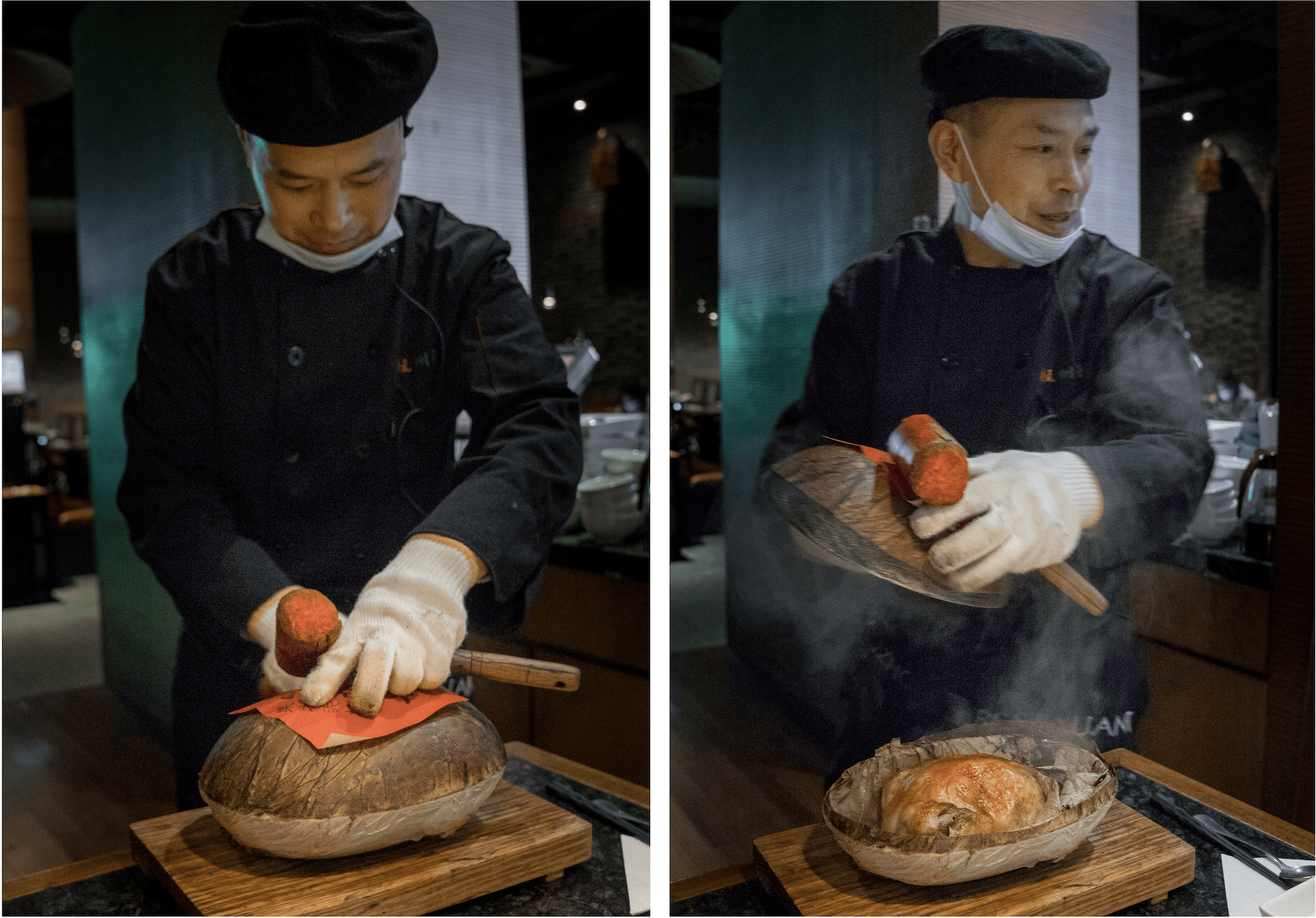

A great and very popular place to try Hangzhou cuisine is simply called Hangzhou Restaurant. The real reason you want to come here is to eat the amazing Beggar’s Chicken, which originated in Hangzhou.
Beggar’s Chicken is a whole chicken that is wrapped in lotus leaves and covered in clay before it is sloooooowly baked (up to 6 hours). According to legend, Beggar’s Chicken came to be after a beggar stole a chicken, but having no cooking utensils, he had to cover it in mud and bake it in the coals.
When you order the Beggar’s Chicken, the chef/ chicken man will bring the chicken to your table. He will then hand you a wooden mallet. After saying a blessing, you need to tap the clay pot with the mallet. This is repeated two more times, at which point the chicken man will open the chicken for you. Seeing your chicken as it’s revealed will be love at first sight.

What to order?
Beggar’s Chicken (果木泥烤叫花鸡). Come here early to get a chicken. The first night, we arrived at 18:00, and they were all gone, so we had to come back the next day.
Longjing Shrimp (龙井虾仁) Peeled, freshwater shrimp infused with Longjing tea leaves and Shaoxing wine.
Dongpo Pork (东坡草扎肉): Not nearly as good as at Green Tea Restaurant, but still pretty damn good.
Vegetables and rice to pretend that you’re not only here for the meat.
Address: 浙江省-杭州市-上城区-延安路205号(近东坡路)
LuYu (炉鱼)


Under the same management of Hangzhou’s famous Grandma’s House, LuYu has the best fish we’ve had in China so far. And I’m pretty sure it will remain our number one Chinese fish place until forever.
What to order?
FISH!
Forget fish and chips. The way the Chinese do fish is quite different. First, the fish is grilled until it’s wonderfully smokey and crispy. Add extras of your choice, such as potato, mushrooms, rice cake, corn or glass noodles. Then it’s smothered in a soup of your choice, from not spicy all the way up to what were you thinking!!!???
We ordered the grilled sea bass (海鲈鱼(烤鱼) with garlic sauce (蒜香味) + less spicy (微辣), which was a match made in heaven. If you have space left at the end, get the delicious Shuāng pí nǎi milk pudding (双皮奶).
LuYu is on the 5th floor of the Kerry Mall.
This address in Chinese will get you there: 浙江省·杭州市-下城区-延安路353号杭州嘉里中心F5
Things to Do in Hangzhou Map
Our 3 Day Hangzhou Itinerary

Here is how we spent 3 days in Hangzhou. Our 3-day itinerary for Hangzhou is relaxed, and we surely didn’t rush from one place to the next. Feel free to adjust it to your needs.
Day 1:
- Arrive in Hangzhou in the morning. Check into accommodation.
- Go to Longjing Tea plantation.
- Dinner at Green Tea Restaurant
Day 2:
- Xiao long bao and dumplings breakfast.
- Ride a share bike to Xiling Seal Art Society.
- Walk along West Lake and cross Su Causeway.
- Grand Canal and Qiaoxi Culture Street.
- Dinner at LuYu
Day 3:
- Starbucks breakfast outside the Lingyin Scenic area.
- Buddha spotting at Fei Lai Feng
- Lingyin Temple
- Xixi wetlands and boat ride.
- Dinner at Hangzhou Restaurant
- Jixianting pavilion and Leifeng Pagoda night views.
Day 4:
- MacMorning breakfast at the train station before catching the train to Suzhou.
How I Shot This Guide
Every photograph in this article was taken with the exact same gear I carry on every journey. It is a setup refined over years on the road to keep travel light without compromising the final image.
- Camera: Sony A7 V
- Lens: Sigma 24-70mm f/2.8 DG DN Art.
- Storage: SanDisk Extreme Portable SSD
- Software: Adobe Lightroom Classic
- Outerwear: My North Face Aconcagua 3 Jacket was warm and perfect for a winter trip to Hangzhou
And that’s how you do Hangzhou. Enjoy your time in Hangzhou. We are sure you are going to love it! Let us know in the comments below if you have any questions.
✌️
I loved this post! Hangzhou has always been on my travel list, and your suggestions are super helpful. I can’t wait to visit West Lake and try the Dragon Well tea. The map is a nice touch too! Thanks for the great insights!