
I spent four days drifting through the colourful alleys of the Harar Jugol, a walled city in eastern Ethiopia that feels like nowhere else on earth. Three hundred sixty alleyways, squeezed into one square kilometre. The city is a maze, both literal and mental.
The alleys tangle like a rainbow of instant noodles. You lose yourself, then find yourself again, somewhere between a shrine and a spice stall and a goat. Children call out faranji (foreigner) from behind purple doors. The air smells of coffee, incense, spice, and dust. It’s a place you need to sit with.
Harar, according to some, is Islam’s fourth-holiest city. Madina al-ʾAwliya – City of Saints – they call it in Arabic. It’s a very conservative part of the world.
To make sense of the maze and culture, I had Adisu, a fixer, translator, and guide rolled into one. He knew which alley held the shrine with the ostrich eggs, who made the best kita bread, where the coffee was the strongest, and where the beer flowed coldest. He also knew when to throw in something… unexpected.
Let’s have a khat party, he said one lazy afternoon, just after ordering a beer at the Harar Brewery.


Khat Culture: The Leaf That Rules the Horn
I knew what khat was.
Khat, for the uninitiated, is a leafy plant with amphetamine-like properties chewed across the Horn of Africa and some parts of the Arabian Peninsula. Chewed fresh, it gives a mild buzz. It’s technically classified as a drug in much of the world, but in Ethiopia, especially in Harar, it’s part of the daily rhythm.
In Harar, khat isn’t just a plant but a ritual. It’s as ingrained as the morning coffee ceremony. It’s social. Communal. A way to share stories, argue politics, pass the long afternoons. Many Hararis chew daily, especially in the afternoons, when the air gets heavy and time slows.
But khat culture stretches far beyond Ethiopia. In Yemen, where it’s even more entrenched, khat sessions are a central part of social and family life. Men, and increasingly women, gather in homes or courtyards every afternoon to talk, chew, and dream.


Much of the khat grown in Ethiopia and neighbouring Kenya makes its way first to Djibouti and Somalia, and then across the Red Sea to Arabia. There’s a booming cross-border trade—legal in some places, smuggled in others.
In Harar, people will tell you the best khat comes from just outside town—places like Aweday and Babile. Farmers harvest before the crack of dawn, and it’s shipped out fast. Freshness is everything. Once it wilts, it’s worthless.
It’s a massive business. And a controversial one. Critics point to water shortages, addiction, lost productivity. But try banning it, and you risk uprooting culture itself.
When Adisu starts texting his friends to set up the party, I say I don’t do drugs, especially not with strangers in a foreign country.
But Adisu grinned.
You’re in Harar, he said. And we’re not strangers.
Buying the Buzz: Fallana Gate’s Finest
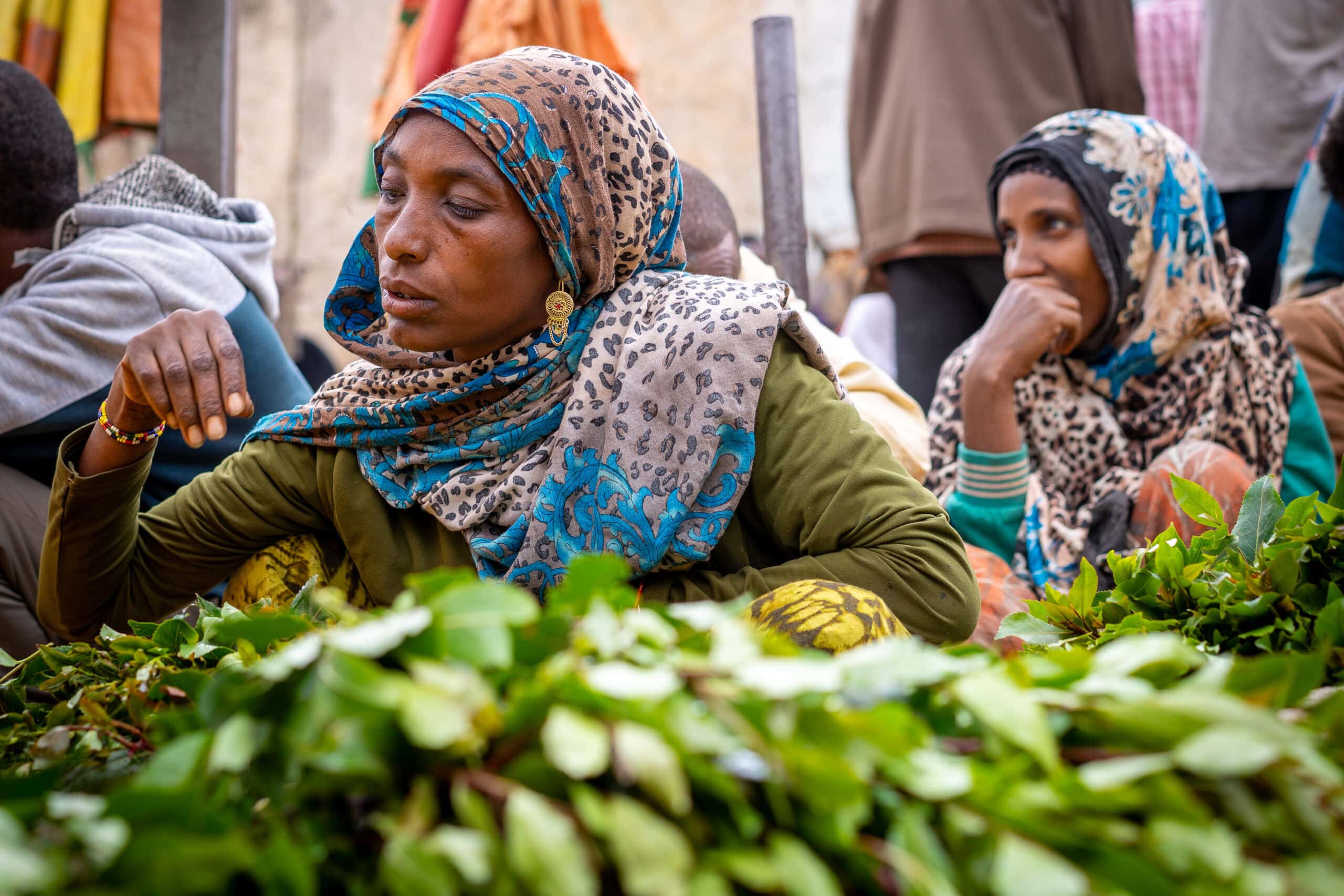
So off we go in a beat-up blue Peugeot taxi. Destination: Fallana Gate Market, one of the old entrances to the city, where, according to Adisu, the best khat in Harar is sold.
You can get it anywhere in Harar. Most street corners have bundles of the green stuff. During my first day in Harar, I thought they were animal fodder. But Fallana Gate is for the discerning chewer.
I hand Adisu a few thousand birr and awkwardly watch the deal go down. Khat buyers are serious. Adisu is like a sommelier picking wine. Bending leaves, sniffing stems, rejecting anything even slightly wilted or twiggy. We walk away with two bags of the stuff like vegans who won the lottery.

The House in the Jugol
We walk our way through the winding alleyways to Hamdi’s house deep inside the Jugol. One of those old Harari homes that seems to hold decades of whispered stories. Carved wooden door. Thick turquoise walls. Soft carpets. The kind of place where light filters in like memory.

It’s me, Adisu, Hamdi, Sam, Walid, and Hali. We sit on the floor. Cushions under us, music playing from a phone. Coca-Cola bottles are passed around, along with peanuts and water.
Then the chewing begins.
How to Chew Khat Like a Harari
Khat tastes like leaves. No surprise there. Like very bitter grass. A bit like matcha, but with bark.
I pluck leaves one by one, like a tea harvester in Darjeeling. Pluck one, chew one, pluck one, chew one. You pluck and chew and chew. Add more leaves and chew more. Swallow nothing. You push the wad into your cheek like a squirrel. Let the juice soak in.
I wasn’t sure it was doing anything—until it was.


The conversation starts flowing faster. Jokes are funnier. Time dilates a little. There’s a low thrum of energy, not unlike your sixth cup of double espresso. You feel wired but mellow. Alert but not anxious. It’s not a high so much as a sharpening.
It was comfortable, strange, electric. I was chewing khat in an ancient house in Harar with people I’d met 15 minutes ago—and somehow it felt perfectly natural.
A Father’s Seal of Approval
We are deep in the chew. My cheeks stuffed, my thoughts are flying sideways, and everyone is laughing at a joke in Harari that I didn’t understand.
The front door creaks open. Footsteps on carpet.
Hamdi’s dad appears in the doorway.
Dad scans the room: six young men on his living room floor, one faranji among them, surrounded by crumpled khat bags and half-finished Cokes.
My mouth is full of leaves. My mind and heart go numb. I imagine him yelling, throwing us out, calling the police, calling someone. I see the headlines already:
Tourist Arrested in Harar Drug Den
Dad walks over to the pile of leftover khat. Bends down. Picks up a handful. Brings it to his nose. Rubs a few leaves between his fingers. Then, slowly, he plucks one. Pops it into his mouth.
Chews.
He nods.
It’s good khat, he says in English, and walks out.
My mind exhales, and I burst out laughing on the inside.
The Hyena Buzz
Still riding the khat buzz, Hali has a suggestion. Let’s take the faranji to go feed the hyenas, he says.
Of course. What better way to round off an afternoon of mild amphetamines than to hand-feed wild hyenas? Everyone, including me, thinks it’s a great idea.
We pile into Halil’s tuktuk and rattle through the city until we reach the outskirts, near one of the gates. It’s already dark. A man stands in the shadows, calling softly into the night with a wicker basket of meat beside him. His voice floats out into the night like a lullaby.

Then they appear.
Hyenas.
Real ones.
First one. Then another. And another. Muscular. Calm. Not quite tame, but not wild either.
The man hands me a stick with a strip of meat hanging off it.
I hold it out. A hyena walks up. Looks me dead in the eyes. Then gently takes the meat from my hand.
Hand-feeding wild hyenas while high on khat might be the most idiotic and most extraordinary thing I’ve ever done in Africa—or anywhere.

Planning a trip to Ethiopia?
Check out these guides for more inspiration:
➜ Things to See and Do in Harar – Explore colourful markets, shrines, and the city’s unique hyena tradition inside the walls of the Harar Jugol.
➜ The Rock-Hewn Churches of Lalibela – A journey through Ethiopia’s most awe-inspiring sacred architecture, carved straight from rock.
➜ Addis Ababa Layover Guide – See the capital instead of only staying in the free layover hotel
A Note on Khat and Culture
I don’t condone or promote recreational drug use, especially while travelling.
But in Harar, chewing khat wasn’t about getting high. It was about connection, about sitting cross-legged on the floor with five young men who welcomed me into their world with humour, hospitality, and trust. Long after the buzz faded, I still remember that afternoon inside the Jugol: the way the sunlight filtered through the windows, the rhythm of our conversation, the laughter that needed no translation.
It remains one of the most unique cultural experiences I’ve had anywhere in the world.