
It’s my second coffee of the morning, still, the words to describe Harar won’t come. Harar resists description. Every line I type sounds like a travel cliché or backpacker blog post.
An assault on the senses. Delete.
A city frozen in time. Spare me.
If I had to pick one word?
Colourful.
If anywhere earns it, it’s Harar. A living kaleidoscope of people, languages, and life.

When I planned my trip to Ethiopia, Lalibela was non-negotiable. But after that? I had a week and too many options. Stay north and explore the cliff churches of Gheralta? Go hiking in the Simien Mountains? Head south and chase tribal portraits in the Omo Valley?
Then I read about Harar. A walled Islamic city in the east, sitting between the Ethiopian Highlands and the Somali coast. A place older than most maps, where wild hyenas still roam the streets at night and people chew bitter green leaves all afternoon.
I was in.


Harar’s fascination lies in its layers. They call this place Madina al ‘Awliya – City of Saints – in Arabic. Sacred to Muslims as Islam’s fourth holiest city (after Mecca, Medina, and Jerusalem), it was once a key trading post between Africa and Arabia. You feel that legacy in the swirl of dialects, spices, and faces.
It’s a place where Amhara, Oromo, Harari, Gurage, and Somali clans all live within the same medieval walls. Where mosques, markets, churches, shrines, and khat sessions collide in a glorious, living chaos. If there’s any place that makes unity in diversity more than just a tourism slogan, it’s this city.
Welcome to the United Colours of Harar.


Please note: This post may contain affiliate links. This means I may earn a commission if you make a purchase by clicking a link (at no extra cost to you). As an Amazon Associate, I earn from qualifying purchases. Learn more.
- Things to Do in Harar
- Where to Stay in Harar: 4 Nights at Rowda Waber Guesthouse
- #11 Coffee: Ethiopia’s Liquid Ritual
- #10 See Everyday Ingenuity at Work
- #9 Shoot the Street
- #8 Rethink Fruit Juice at Tesga Juice
- #7 Arthur Rimbaud Museum
- #6 Visit the Sherif Harar City Museum
- #5 Have a Cold One at the Harar Brewery
- #4 Get Lost in the Harar Jugol
- #3 Go Somali Spotting and Camel Shopping at the Babile Camel Market
- #2 Dive into the Harar Markets
- #1 Feed the Wild Hyenas of Harar
- Harar FAQ
➜ Suggested Guide in Harar
You can’t truly see Harar without a Harari guide. My fixer, Adisu, knew every corner. He pointed out the hidden shrines, the oldest mosques, the best coffee spots. This city of 368 narrow lanes is a maze—one where a local voice matters. On my own, I would’ve missed half the story.
Contact Adisu on WhatsApp +251 94 010 4947 or harar18@yahoo.com
Things to Do in Harar
Whether you’re planning a trip to Ethiopia or you’re an armchair traveller, I want to show you what’s inside the ancient walls of Harar. Here are my 11 best things to do in Harar, perhaps Africa’s most colourful city.
Where to Stay in Harar: 4 Nights at Rowda Waber Guesthouse


The best place to stay in Harar isn’t a hotel. It’s inside the Jugol, the old walled city, tucked behind thick wooden doors and hidden courtyards. I stayed at Rowda Waber Guesthouse, and honestly, I wouldn’t have wanted to be anywhere else.
Staying in a traditional Harari home is more than just a place to sleep—it’s an experience. Rowda Waber is simple, yes. But it’s also warm, welcoming, and packed with personality. The kind of place where you trade hotel amenities for something infinitely richer: local life.
The house wraps around a leafy courtyard dotted with succulents growing out of old tins and cooking oil bottles. I stayed in the courtyard room—a large space with a comfy double bed and its own lounge area, perfect for sprawling out on the carpet after a long day. The bathroom is shared, but it’s all part of the communal charm.
And then there’s Rowda herself—a lovely host who makes you feel instantly at home. Breakfast is served either in your room or in her own living room, which looks like a small museum. Every inch of the whitewashed walls is covered in colourful grass baskets, clay pots, teacups, plates—a kaleidoscope of everyday beauty.
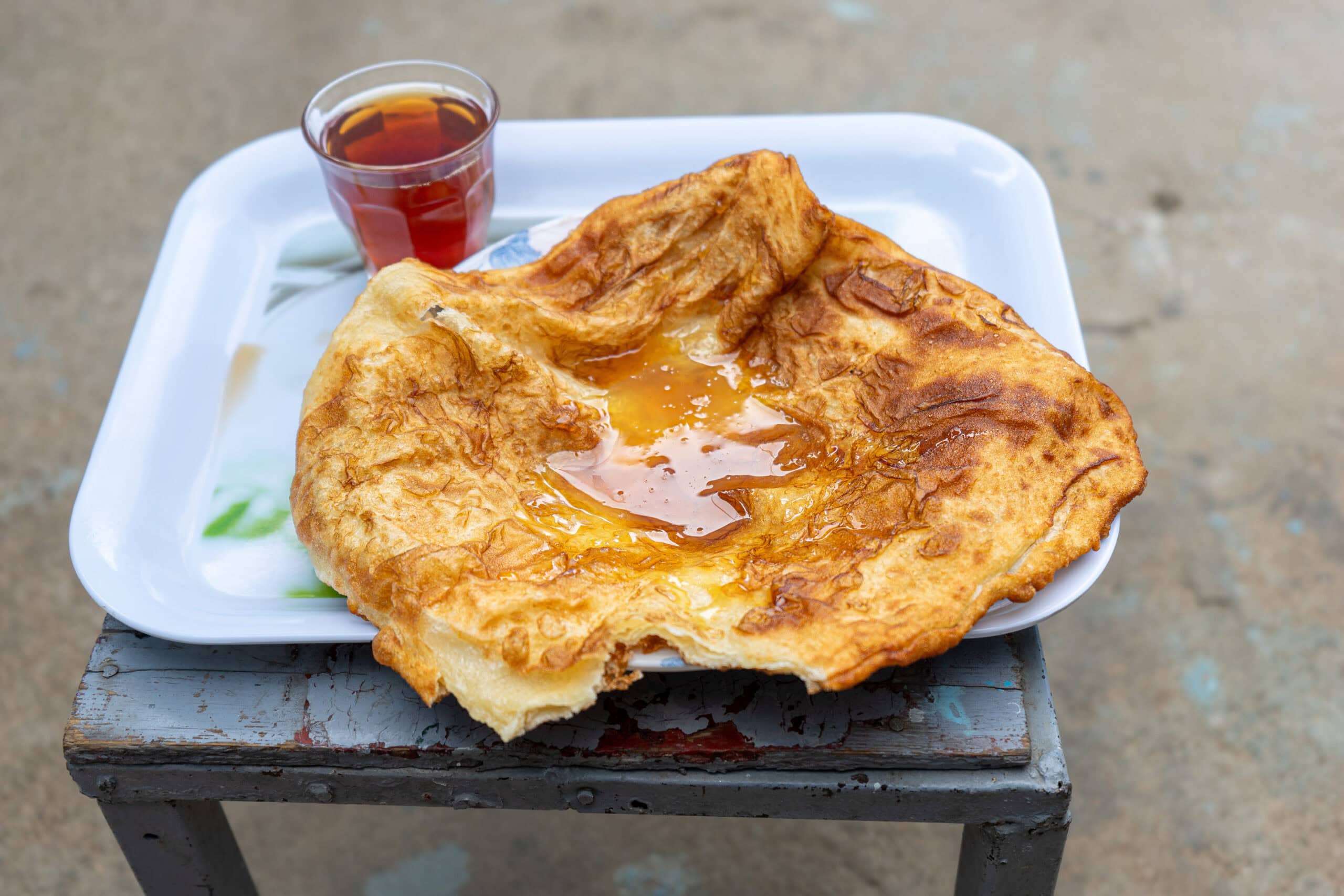
She serves up a dynamite breakfast with golden flatbreads, sticky honey, fresh tea, and strong Harari coffee. The kind of meal that fills your belly and sets the tone for the day.
To book, contact her niece Ayisha on WhatsApp at +251 92 187 2867. She’s also a guide and can help you plan your time in Harar.
While there are a few hotels outside the Harar city gates where you could stay, nothing beats the atmosphere and hospitality of staying at a traditional Harari house in the Jugol.
The Ras Hotel is probably the best choice if you really feel the need to stay outside the Jugol. The Ras Hotel features a good restaurant and bar, open to the public.
#11 Coffee: Ethiopia’s Liquid Ritual


Yes, Ethiopia is where coffee began, but Harar feels like the birthplace of Ethiopian coffee culture. And thanks to a brief Italian occupation in the 1930s, some cafés still sport vintage espresso machines you won’t find outside of Rome.
Harar coffee is dry-processed—sun-dried, hand-sorted, no shortcuts. Maybe that’s why it tastes like the earth and the sky had a conversation and decided to make something warm and strong and slightly wild.
You get two kinds of coffee here. The traditional stuff—buna—is made with green beans roasted over charcoal, with a bit of incense thrown on the fire. There’s something almost theatrical about the process. Beans sizzling in the pan. The grinding. The clay jebena bubbling over. Then it’s poured low and slow into tiny cups, dark as sin, smooth as silk. You don’t chug it. You sit with it.
Then there’s the macchiato. A leftover from the Italians. The story goes that they were only here for a couple of years (1935- 1937, never fully colonised). The Italians left, but the coffee machines stayed behind. Some cafés still use those hulking old espresso makers that wheeze and hiss like they’ve seen some things.
Order a macchiato. It’ll come in a glass cup, frothy on top, thick at the bottom. Probably the best coffee I’ve ever had. No fanfare. No latte art. Just honest coffee, made by someone who’s been doing it for decades.
It ruins you a little. Because after Harar, coffee everywhere else just tastes like a compromise.
#10 See Everyday Ingenuity at Work


Walk around Harar for even an hour and you’ll see ingenuity on every corner. People making do, and then some.
Africans have a way of turning lemons into lemonade, and in Harar, it’s on full display. There’s a whole market—called the Recycling Market—dedicated to sorting and selling what most people would call trash. Bottle caps, wires, rubber scraps. Nothing is wasted. Nothing is without value.
You’ll pass women frying sambusas in alleyways, kids selling gum with the confidence of CEOs, and men pushing carts stacked with second-hand goods they’ve polished into something new. It’s all hustle. Not in a desperate way. There’s pride in it. Optimism, even.
One afternoon, my flip-flop snapped. Before I could even curse under my breath, a guy appeared like he’d been summoned. He motioned to the broken strap, nodded, and gestured for me to follow. Two minutes, a flame, and a bit of wire later, it was good as new. Cost me a few Birr and a smile.
It’s not charity. It’s not pity. It’s enterprise. And it’s everywhere.
#9 Shoot the Street


Harar is hands-down the most photogenic city in Ethiopia. The colours, the textures, the chaos. Everything begs to be photographed.
Old Peugeots rattling through alleys, donkeys balancing crates, spices spilling out of sacks in the market, kids in neon shirts darting past crumbling mosques. Around the city gates, there’s always something happening—bustling trade, arguments, laughter, the occasional goat getting in the way.
But photographing people here is a different game. Hararis are, for the most part, conservative and very camera-shy. Don’t expect to walk around snapping portraits without consequence. The exception, of course, is the kids. They love the camera. Pose, click, and they’ll rush to your LCD screen like it’s a magic mirror.
My most memorable encounter? I was walking through the Jugol, camera tucked away, when a tiny hand grabbed mine. “Faranjo! Faranjo! My name is Lonny. You must come and see!” He dragged me down a side alley, told me to wait, then zipped back on a little bicycle. “Where’s your camera?” he demanded.

If you’re hoping to capture people here, the best advice I can give is: engage first. Chat, smile, buy some fruit. Or find a quiet corner, sit, and wait. The scene will come to you. Sometimes, after a few words, someone will actually ask you to take their picture.
In Harar, the stories and photos often find you. You just have to be patient.
#8 Rethink Fruit Juice at Tesga Juice

Before coming to Ethiopia, I knew all about the coffee. What I didn’t expect was the fruit juice. Thick, fresh, vibrant, and wildly addictive. Locals call it Spreece, a layered drink that looks and tastes like a melted rainbow.
The best juice I had in Harar—and maybe anywhere—was at Tesga Juice, a tiny shop just outside the Harar Gate, up on the first floor next to the Bank of Abyssinia. It doesn’t look like much from the outside, but trust me, it’s worth the climb.
I ordered a mix of avocado, mango, guava, and papaya. Thick like a smoothie, no added sugar, and filling enough to count as lunch. You can also order single-fruit juices, but the layered mix is where the magic happens.
It’s the kind of drink that makes you pause between sips just to savour it.
#7 Arthur Rimbaud Museum


There’s something odd about finding a museum dedicated to a French poet in a conservative Islamic city in eastern Ethiopia. But Harar is full of contradictions, and the Arthur Rimbaud House is one of the most beautiful.
Don’t worry if you’ve never heard of Arthur Rimbaud—I hadn’t either until I ended up in his namesake museum in Harar. Tucked inside a beautiful old Indian merchant house in the Jugol, the museum is worth a visit for the building alone.
Rimbaud was a French poet who gave up writing at 21, travelled to Ethiopia, and settled in Harar around 1884. He became one of the first Europeans to enter the walled city and, lived his best life as a gun runner and coffee exporter.
The museum doesn’t have many of his original belongings, but the second floor houses a collection of early photographs—some said to be taken by Rimbaud himself—that capture everyday life in Harar over a century ago. Looking at those images, it’s surprising how little has changed.
The colourful windows upstairs offer one of the best views over the rooftops of the old city. It’s quiet and atmospheric. Like a small slice of 19th-century France dropped into the Horn of Africa.
#6 Visit the Sherif Harar City Museum

For a broader view of Harar’s history, stop by the Sherif Harar City Museum, also known as Ras Tafari’s House. This was once the honeymoon home of Haile Selassie, then known as Ras Tafari.
The museum is intimate and homey, displaying a collection of manuscripts, textiles, jewellery, coins, and weapons that chart Harar’s long history. The setting feels more like a traditional Harari home than a formal museum, which adds to the charm.
If you’re on a mission to understand the layers of culture in this historic walled city, don’t skip it.
#5 Have a Cold One at the Harar Brewery

Yes, there’s a brewery in Harar. And yes, it serves alcohol—even though Harar is one of the holiest Islamic cities in the world.
The Harar Brewery is a bit of an anomaly, but a very welcome one on a hot afternoon. They brew a crisp pale lager (5%) and a surprisingly good stout (5.8%), plus a non-alcoholic version called Harar Sofi for the local market.
Guided tours of the brewery are sometimes available according to Adisu. Not during my visit to Harar, but that didn’t stop us from visiting the clubhouse. It’s a no-frills kind of place, with plastic chairs outside under the trees.
There’s something deeply satisfying about sitting in the brewery’s backyard, sipping on a cold beer, and ordering a plate of golden fries with a side of spicy sauce.
I particularly enjoy the quiet rebellion of drinking beer in a holy city.
#4 Get Lost in the Harar Jugol


Enclosed by five gates and five-meter high stone walls, the Harar Jugol traces back to the 1560s. The old city is a maze of more than 360 alleyways, squeezed into one square kilometre. The walls are thick, the alleys narrow. It’s basically a maze that swallowed a rainbow.
There are 82 mosques, over 100 shrines, and thousands of traditional Harari homes packed into this tight labyrinth of pastel alleys and narrow turns. No wonder it’s a UNESCO World Heritage Site.


The best way to really see Harar is to get a guide, at least for your first day. Mine, Adisu, took me to shrines I would’ve walked right past, explained the unspoken rhythms of the city, and brought me to the most fascinating place: the Alley of Reconciliation.
This passage is so narrow that two people can’t pass unless one steps aside. When there’s tension between friends, their families will “accidentally” send them through at the same time, forcing a conversation, and hopefully, forgiveness.
It’s beautifully symbolic.
After that, I just wandered. The Jugol rewards curiosity. You’ll get lost. That’s the point. But as Adisu told me:
The Jugol is like an egg:
If you’re going downhill, you’ll hit the wall or a gate.
If you’re going uphill, you’re going back to Feres Megala, the centre.
#3 Go Somali Spotting and Camel Shopping at the Babile Camel Market


Every Thursday, the plains near Babile come alive with one of the most fascinating markets in Ethiopia. The Babile Camel Market is just an hour from Harar by minibus, and it feels like crossing a border without leaving the country.
The traders are Somali, not Harari, and you notice the shift in atmosphere right away. More conservative, more reserved, and definitely less enthusiastic about cameras.
Still, if you’re curious and respectful, it’s an incredible glimpse into another world. Camels of all sizes stand calmly under the sun, some with gentle eyes, others defiant and loud. You’ll also see herds of goats, sheep, and cows, each attended by owners with obvious pride. The animals are in good condition, the deals are serious, and the vibe is utterly authentic.
Most camels sold here are bound for Saudi Arabia. The lucky ones will race. The less fortunate will end up in someone’s Friday night kebab. Either way, it’s a spectacle worth seeing, even if you’re not planning on buying a baby camel.
Guidebooks will tell you of the nearby Valley of Marvels with its odd rock formations.
I went. A ten-minute tuk-tuk ride from the Camel Market on the road to Somaliland.
Don’t bother.
Minibuses to Babile leave from Harar’s bus station, across from the Shoa gate. The cost is around 10 birr one way. These minibuses leave when they are full, so you might have to wait a while until your van fills up.
#2 Dive into the Harar Markets
Harar’s markets aren’t just where people shop, they’re the lifeblood of the city. Each one hums with a different energy, reflecting the ethnic group it serves. You probably won’t buy much (unless you’re after mangoes or khat), but you’ll leave full of colour, smells, and stories.
The Christian Market


If you came in by bus from Dire Dawa, the Christian Market (or Shoa Gate Market) is your first welcome to Harar: a chaotic sprawl of incense smoke and spice mounds spilling out from crumbling doorways.
In daylight, it’s mellow: women selling custard apples, men hawking what looks like glittering rock candy (tree resin incense used in coffee ceremonies).
But wait until late afternoon when it surges with commuters making last-minute buys.
For fantastic photos, cross the road and climb to the first floor of the building opposite Shoa Gate. From there, the market spills out beneath you, framed by the Shoa Gate and the Jugol behind it.
Recycling Market

Nothing is wasted here. Glass bottles are stacked by colour. Men hammer rusted tin into usable pots, while others sit and chew khat outside their stores, waiting for a customer to come and buy an old Betamax video player from 1982.
You’ll find old TVs, mangled radios, cords and cables, and tonnes of glass and plastic. One man’s trash is…still kind of trash, but it has value here. Welcome to circular economy, Harar-style.
Oromo Market


Just outside Erer Gate—the place where Richard Burton snuck through disguised as an Arab merchant to become the first European inside Harar—lies the Oromo market, a riot of colour and noise. This market is one of the most colourful places in Harar.
Donkeys stagger under mango-laden sacks, women in brilliantly patterned shawls haggle with ease, and if you time it right (morning’s best), you’ll see the place in full swing.
Nearby, there’s a mosque with a minaret. Smile politely, and you might get invited to climb to the top. I did, and the view over the market was just great.
Khat Markets

Khat. Or chat. Or qat. Or miraa. Call it what you like, just don’t mistake it for salad. Those leafy bundles everywhere? That’s khat. Harar’s green gold.
The hills around Harar produce not only some of the best coffee in the world, but also the world’s finest khat. Not that I know, of course, but that’s what the khat connoisseurs claim.
Even though the WHO classifies it as a drug, it’s legal, cheap, and loved in Harar. A mild stimulant, khat gives a gentle buzz and makes you want to talk about politics or absolutely nothing for hours. Most of it ends up in Somaliland or Yemen, but plenty is chewed right here.
Mostly chewed by men and sold by women, you’ll see khat for sale all around Harar; however, the Fallana Gate is where you’ll find the best stuff…or so I’ve been told 😊
➜ Read more
High in Harar: Chewing Khat in Ethiopia’s Ancient Walled City
Muslim Market (Gidir Magala)

Smack in the middle of the old town is Harar’s butchery district. If you’re vegan, vegetarian, or squeamish, keep walking.
Here you’ll find camel meat in every possible form, from mince to whole hump. For a thrill, buy a scrap and raise it skyward. A hawk will dive from nowhere, snatch it mid-air, and vanish.
It’s fast, brutal, and unforgettable, just like the market.
Makina Girgir Street

This isn’t a market per se, but it deserves mention. Makina Girgir is the thrum of Harar’s tailoring industry. A whole street of tailors hunched over sewing machines.
Makina is the brand (Italian, a relic of the 1930s occupation), and girgir is the sound the machines make. You’ll hear it before you see it: girgirgirgir.
Need something altered, mended, or made from scratch? This is the place.
#1 Feed the Wild Hyenas of Harar

Of all the things to do in Harar, feeding the wild hyenas is the one that sticks with you. It is equal parts thrilling, surreal, and deeply rooted in local tradition.
There are Hyena Men in other parts of Africa, like Nigeria and Malawi, but the ones in Harar are the most well-known.
The practice likely began during a severe drought in the 1950s, when hungry hyenas started attacking livestock, and sometimes people. To keep the peace, Hararis left food outside the city walls. A full hyena, they reasoned, would be a good neighbour.

Over time, this uneasy truce became a nightly ritual. Today, there are two Hyena Men in Harar who feed scraps of meat to the hyenas outside the city gates. Visitors can watch or even take part in the feeding. It is not a gimmick. These hyenas are wild and free to come and go.
Before anyone clutches their pearls—no, the hyenas are not in captivity. Hararis treat them with respect and even believe they protect the city from evil spirits. This is not exploitation. It is coexistence.
Feeding begins around 18.30. One of the best spots is near the garbage dump outside Erer Gate, about two kilometres from the old town. Go with a guide and take a Bajaj. Do not walk. It is dark, and yes, the hyenas are still wild.
When the hyenas emerge from the shadows, your instincts may tell you to run. But stay. The Hyena Man hands you a short stick with a piece of meat. You hold it out. Then—snap—it is gone, taken by jaws that can crush bone.
A small payment of 100 Birr (around three dollars) is expected, most of which likely goes towards feeding the hyenas, not the man.
Harar FAQ

How to Get to Harar
Bus: If you are the kind of person who enjoys whips, chains and self-torture, you will be pleased to know there is a bus from Addis Ababa to Harar. Sky Bus and Selam Bus both leave from Meskal Square early in the morning. The ride takes about ten hours. It feels like twenty.
Plane: For the rest of us, Ethiopian Airlines is the way to go. Fly to Dire Dawa, which is the closest airport to Harar. From there, hop in a taxi to the main bus station, then catch a minibus to Harar. They leave every ten minutes or so and take about an hour. It is fairly painless.
Do I Need a Guide in Harar?
I am not usually a fan of guides. I like to wander, get lost, ask awkward questions. But Harar is different. A guide here is more than just someone pointing at buildings. They unlock doors, explain the unspoken rules, and help you see the layers beneath the surface.
The old town is a proper maze. You could lose yourself after breakfast and not find daylight again until sunset. A guide will help you get your bearings on day one. After that, you can explore on your own.
My guide in Harar became a mate. We drank cold Harar beers waiting for hyenas, sipped coffee in the shade, and even ended up chewing khat with his mates.
Ask your guesthouse to set you up or get in touch before you arrive. I recommend Adisu. Reach him on 094 010 4947 or harar18@yahoo.com.
Solo female travellers might prefer Ayisha. She is the niece of the owner at Rowda Waber Guesthouse. WhatsApp her on 092 187 2867.
How Many Days in Harar?
I stayed four days and did not regret it. At minimum, give Harar three. It is not the kind of place you want to tick off and move on. It deserves time.
The best things to do in Harar offer a window into a world unlike anywhere else. Give it a few days, and this city will stay with you long after you leave.
✌️
This is one of the most well-written and comprehensive blog posts I’ve ever come across – thank you ! Harar is one of the few places that’s definitely open right now due to the Tigray civil war so we’re excited to add it to our itinerary in a few months
Thanks Katie,
Harar is an incredible place, we are sure you’ll love it. The coffee alone is worth the trip! Definitely stay inside the Jugol when you go.
Hey this is Adisu’s new number if you want to contact him on WhatsApp // email ( I’m with him right now and he’s amazing!).
+251 94 010 4947
harar18@yahoo.com
Hi Alex,
Thanks for the info. We have updated the post with Adisu’s new contact details. Enjoy the rest of your time in Ethiopia.
Thank you for the detailed and picturesque blog. It also convinced us to go to Harar, which ended up being one of the highlights of our Ethiopia trip.
Rowda guesthouse can also be booked via the number on Google Maps (+251 95 274 7434; whatsapp). That goes to Rowda directly and not through Ayisha who takes a commission (she does not work there anymore).
Hi Oliver,
Yes, Harar really is something special. Glad to hear our post convinced you to go.
Thank you so much for the update on Rowda. I’ll update the post to show her new number. I was under the impression Ayisha was Rowda’s niece, but I guess if she takes commission it might not be the case.