
Visitors quickly fall for Yogyakarta in Central Java. (Those who had fallen under her seduction lovingly call her Jogja) The vibrant and friendly city is the epicentre of Javanese culture and seduces visitors with fantastic food and great things to see and do. Plan your visit to beautiful Yogyakarta with our tried and tested 3-day Jogja itinerary.
People love Jogja for many reasons. It has some of the most incredible temples in the world, the food and coffee alone are reasons to come, and it has a lively arts scene. As the only city in Indonesia still ruled by a Sultan, Joga immediately feels exotic and different from other cities in the archipelago nation.
Temples, street art, batik, charcoal coffee, and gudeg aside, we will return to Jogja for the people. Their unforced smiles and genuine friendliness are why we love Yogyakarta so much. We are sure you’ll feel the same after spending a few days in Jogja.
This Jogja itinerary shows you the best things to see and do in Yogyakarta over three days.

Please note: This post may contain affiliate links. This means I may earn a commission if you make a purchase by clicking a link (at no extra cost to you). As an Amazon Associate, I earn from qualifying purchases. Learn more.
Quick Guide to Yogyakarta
Visited: February
Suggested time: 3 days
Where to stay: Gallery Prawirotaman
Famous for: Borobudur temple, street art, kopi joss, batik, Javanese culture
Transportation: Yogyakarta International Airport serves the rest of Indonesia, Malaysia, and Singapore. Rail enthusiasts can get to Jakarta in about 8 hours. Use metered Bluebird taxis in the city, or get a driver for the day. Becak (a traditional cycle rickshaw) rides are fun and an essential Jogja experience.
Tip: Drop in at Via Via in Prawirotaman for yummy food and unique tours that directly involve and benefit the local community.
Unique experience: Go on a becak ride through old Jogja.
Our 3-Day Jogja Itinerary
We came to Yogyakarta to explore the food and culture of Java. While we wanted to see the main attractions such as the Water Palace and Borobudur, we also wanted a relaxing holiday.
With only three days in Jogja, we had to balance sightseeing, spending time by the pool at our lovely hotel in Prawirotaman and hanging out in warungs and cafes.
If you, too, are looking for a well-balanced Jogja itinerary that will show you the best cultural things to do while unwinding at the same time, we’ll be bold enough to say that our’s is PERFECT!
Here is what we did with our three days in Yogyakarta:
- Day 1: Explore the Kraton area & Malioboro Street
- Day 2: Borobudur Sunrise , Klinik Kopi & Prawirotaman
- Day 3: Beringharjo Market, Bird Market & Foodie Tour
Where to Stay in Yogyakarta
We stayed in the lovely Prawirotaman area, known for its trendy cafes, street art and youthful vibes. If you’re looking for a relaxing place to stay with many excellent options for eating and drinking, stay in Prawirotaman.
At first, we considered staying near Malioboro Street, but after visiting Jogja, we’re glad we didn’t. Malioboro is just too busy, and Prawirotaman is a lot prettier and quieter.
We stayed at the excellent Prawirotaman Gallery Hotel in the heart of this trendy, hipster neighbourhood. Rooms are spacious, air-conditioned and well-equipped for a comfortable stay. They also provided free airport transfers since we were staying for three nights. (Send them a message after booking to arrange this).
The absolute best thing about Prawirotaman Gallery is its outdoor pool! It’s the perfect spot at any time of day.
Other facilities include a spa, massage and a gym. The included breakfast is tasty and has Indonesian and western food on offer.
Day 1: Kraton Area & Malioboro Street
Alun-Alun Kidul

This square in front of the Kraton (Royal Palace) is one of the best places in Yogyakarta to see local culture. It’s always bustling with life and activity, especially around sunset when food stalls are set up here.
You will want to come back here after dark to see a whole different side to Alun-Alun Kidul. (We will be back here on the evening of day 3).
In Jogja culture, the two enormous banyan trees named Pohon Beringin Kembar standing in the middle of the square are significant. In the past, the sultan had a moral test for anyone wishing to work in the Kraton as he employed only those with honest intentions and a good heart.
Potential employees were blindfolded and had to walk straight from the Kraton’s entrance and pass between the two trees (a distance of about 50 metres). Missing the trees meant that you were not pure of heart and therefore could not work for the sultan.
Today local tourists test their character by trying to do the same- not to work in the Kraton, but they now believe your wish will come true when walking blindfolded between the trees.
It’s pretty entertaining watching these hopefuls failing miserably more often than not. That being said, we tried it ourselves, and it’s indeed much harder than it looks.
Kraton/Royal Palace

The Kraton (also spelled keraton or karaton) is home to the reigning sultan and his family and a centre of Javanese culture. This palace is the cultural and spiritual heart of Jogja.
Constructed for the first sultan of Yogyakarta in 1755, the Kraton is a complex of intricate courtyards and pavilions that visitors can admire. The architecture is said to reflect the relationship between God, man, and nature.
Besides the architecture, you’ll see the Abdi Dalem or the sultan’s servants. Barefoot and dressed in batik sarongs and headdresses, these servants devoted themselves to serving the Kraton. Serving the Kraton with pride is a noble loyalty passed down from generation to generation.
Visitors can attend a daily performance in the inner pavilion (included in the entrance fee). You can expect a gamelan performance on Monday and Tuesday, a wayang golek (puppetry) on Wednesday, classical dance on Thursday, Javanese poetry on Friday, shadow puppets on Saturday, and Javanese dance on Sunday.
The Kraton might be a little underwhelming, but with an entrance fee of less than a dollar, it’s worth a quick stop.
Taman Sari Water Castle


Located in the Kraton area, the Tamansari, or Water Castle, is just a short becak ride away from the Kraton itself. A lovely walk from the Kraton will get you to the entrance of the Water Castle in about 15 minutes.
Taman Sari, also known as the Garden of the Sultan, was built in 1765 as a retreat for the first Sultan and his family.
The bathing pools named Umbul Pasiraman are the main attraction. Here, the Sultan’s harem of wives, princesses, and concubines could relax and bathe. The Sultan loved hunting deer, but he would come to these pools to hunt for a wife. He would watch the women from a nearby tower and throw a rose at the one who had caught his eye.
Opening Hours: 9:00 – 15:00 (Daily)
Entrance Fee: Rp. 12,500
Sumur Gumuling/ Underground Mosque

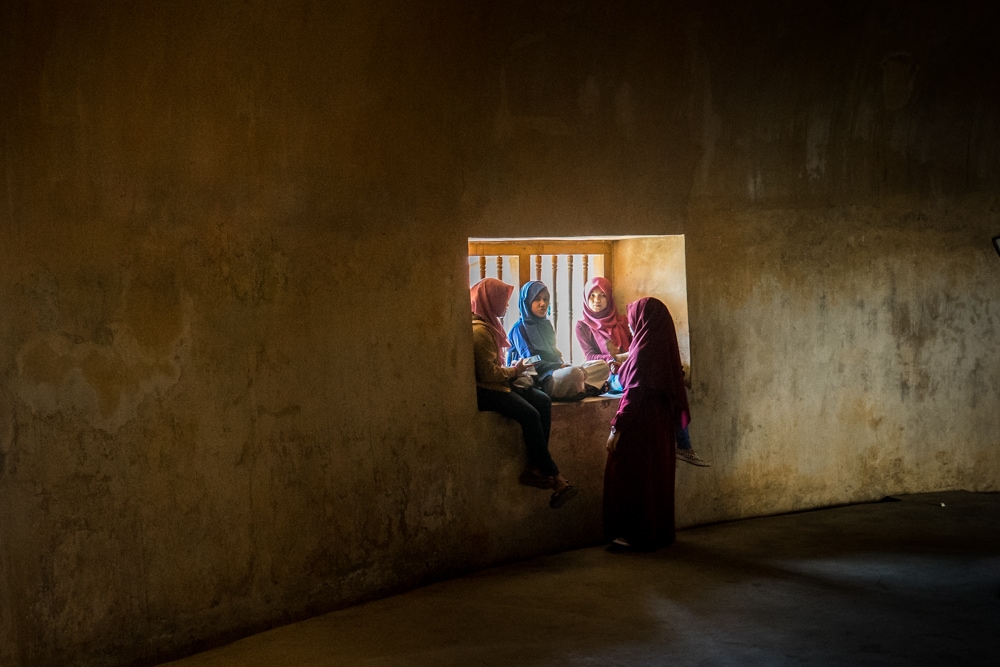
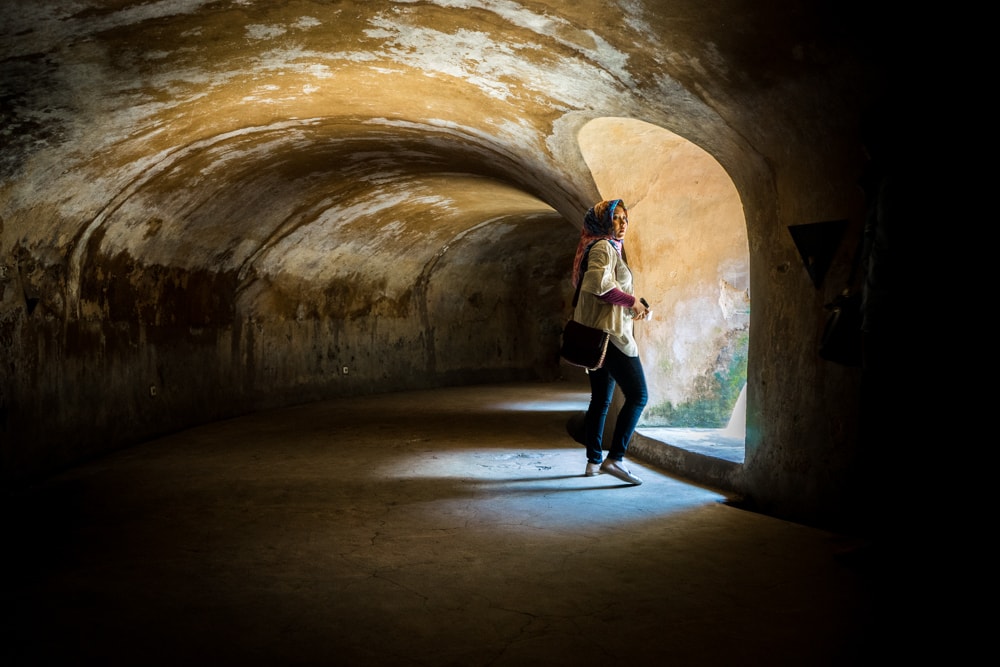
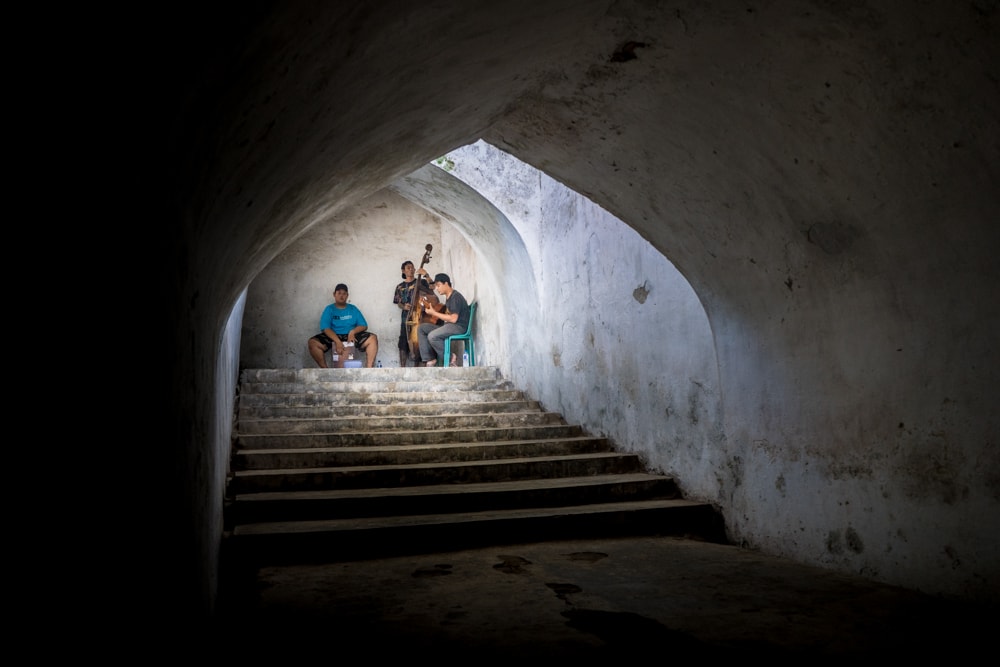
For us, the underground mosque was the most interesting part of the Kraton area. Originally built as part of the Taman Sari, the underground mosque now has a separate entrance a short walk from the Water Castle. It is one of Indonesia’s most unique landmarks.
Finding the entrance is a little tricky, as it’s very nondescript and easy to miss. Ask for Sumur Gumuling when you need directions.
Once you’ve found the entrance, a coil of tunnels and subterranean passages will lead you to the circular opening at the centre of the complex. In the centre, several staircases leading from the underground passages meet, and this is a hotspot for taking photos.
The underground paths are cool, damp and mysterious. They also have excellent acoustics that buskers take advantage of.
Opening Hours: 8:00 – 15:00 (Daily)
Entrance Fee: Included in Taman Sari
Jalan Malioboro

Yogyakarta’s most famous shopping and eating street runs along an imaginary line between Mount Merapi, the Kraton and the Indian Ocean. In the past, Malioboro was the ceremonial avenue the sultan passed on his way to and from the Royal Palace.
Today, Jalan Malioboro is crammed with souvenir and batik shops. We lost interest in the batik shops and curio stands pretty quickly, but the best thing about Malioboro is the lesehan that spring up here after sunset. The entire Malioboro sidewalk is crammed with these food tents after dark.
Lesehan is a roadside food tent where you sit cross-legged on the floor at a low table. The atmosphere is incredibly convivial, and spending the night with the friendly locals while enjoying live music performances and drinking charcoal coffee is Jogja nightlife at its best.
A must-try at a Malioboro lesehan is Kopi Joss (charcoal coffee). It starts as a regular cup of Java coffee with ground coffee, sugar, and hot water. But then a burning red piece of charcoal is dropped into the cup of coffee! Watching the charcoal bubble and sizzle as it cools down is quite satisfying.
Once it has cooled down, you can scoop out the piece of charcoal and enjoy your charcoal-infused coffee.
Day 2: Borobudur & Prawirotaman
Borobudur

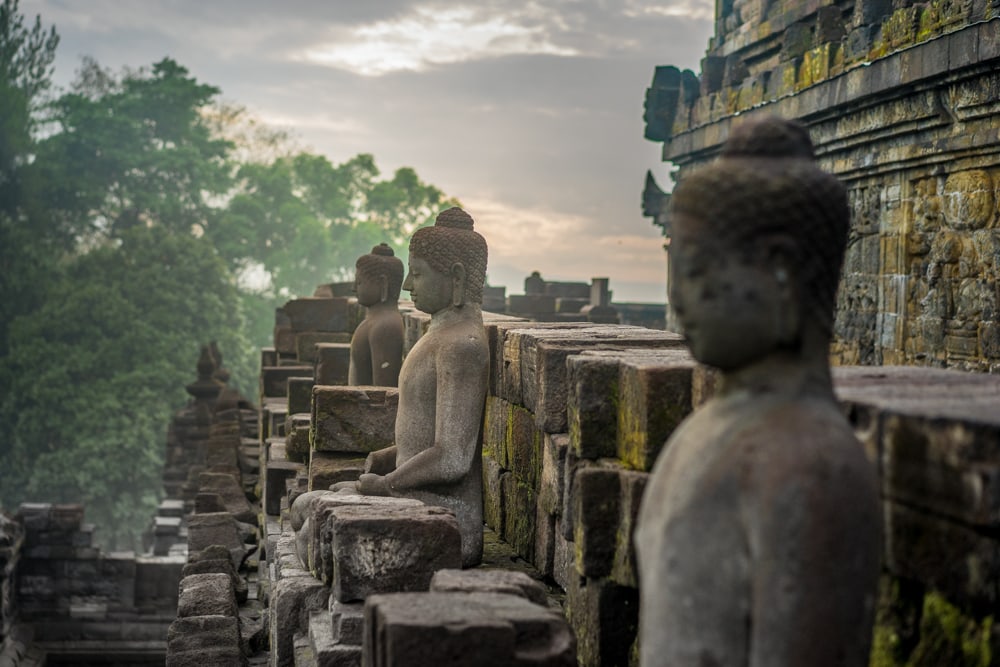
It’s an early start today, but seeing the sunrise at Borobudur will probably be the highlight of your Jogja trip. You should leave Yogyakarta no later than 03:30 to make it in time for sunrise. Ask your hotel the day before to arrange a car and driver for you, or join an organized tour.
Borobudur is the world’s largest Buddhist temple, and this man-made mountain of buddhas and stupas is the best example of the glory of the Javanese kingdom.
Borobudur is one of Indonesia’s most popular tourist attractions, making sunrise the best time to come. You will pay a little extra, but this ensures that you can appreciate the beauty and serenity of the temple in relative peace. The soft morning light is also the best time to take pictures.
Read everything you need to know about sunrise at Borobudur here.
Relax at Your Hotel

Most people will want to carry on to Prambanan temple after visiting Borobudur. This sounds very exhausting, so we headed back to our hotel for a quality nap followed by some time in the pool and a heavenly massage.
Yes, we went to Yogyakarta and didn’t go to Prambanan. Please don’t hit me over the head with your Lonely Planet
You can expect to be back in Jogja by mid-morning, so plan to spend a few hours simply enjoying being on holiday without sightseeing. Don’t underestimate the ability of a massage to give you that I’m on holiday feeling!
Klinik Kopi

Kick off the afternoon with a caffeine kick at Yogyakarta’s most unique coffee shop.
Klinik Kopi is a concept coffee shop like we’ve never seen before. The idea is that you come here for a coffee consultation, almost like going to see a doctor at a clinic.
Owner and barista, Mas Pepeng, will be your doctor and find your coffee fix for you. He provides one-on-one service, only serving pour-over coffee.
When you get to the front of the line (yes, it’s popular, and you’ll have to wait since he only consults one customer at a time), Mas will ask about your coffee preference and how you enjoy coffee. Please don’t ask for a skinny late or cappuccino, as there is no milk or sugar here.
Mas will recommend a coffee bean for you, chit-chat about its origin and flavour, and share his coffee knowledge as he brews your cup. It is one of the most unique cups of coffee you’ll ever have.
There is no Wifi at Klinik Kopi, as Mas Pepeng wants his clinic to be a place for talking and sharing stories. We think it’s a brilliant idea.
The Coffee Clinic is only open between 16:00-20:00 from Monday to Saturday. It’s best to come here soon after they open to avoid waiting in line for your consultation too long.
Explore Prawirotaman

The Prawirotaman area is the artsy, hipster heart of Yogyakarta, packed with cool coffee shops, cafes, galleries and street art. A stroll down Jalan Prawirotaman or Jalan Gerilya will take you to the hottest addresses in Jogja.
There is something out there for every kink and style, so explore until you’ve found the spot that syncs with your personality.
Some hotspots to look out for:
- Move on: A coffee bar by day serving up speciality coffee and craft beer at night. Mostly western food such as pizza, pasta and burgers.
- Tempo Gelato: For the best ice cream in town.
- Sellie Coffee: Intimate and cheap, often with live music or someone strumming a guitar.
- Cuba Bar: Colourful and chilled with great music and a pool table-just how we like it.
- ViaVia: This is a Prawirotaman institution and must not be missed.
Dinner at ViaVia

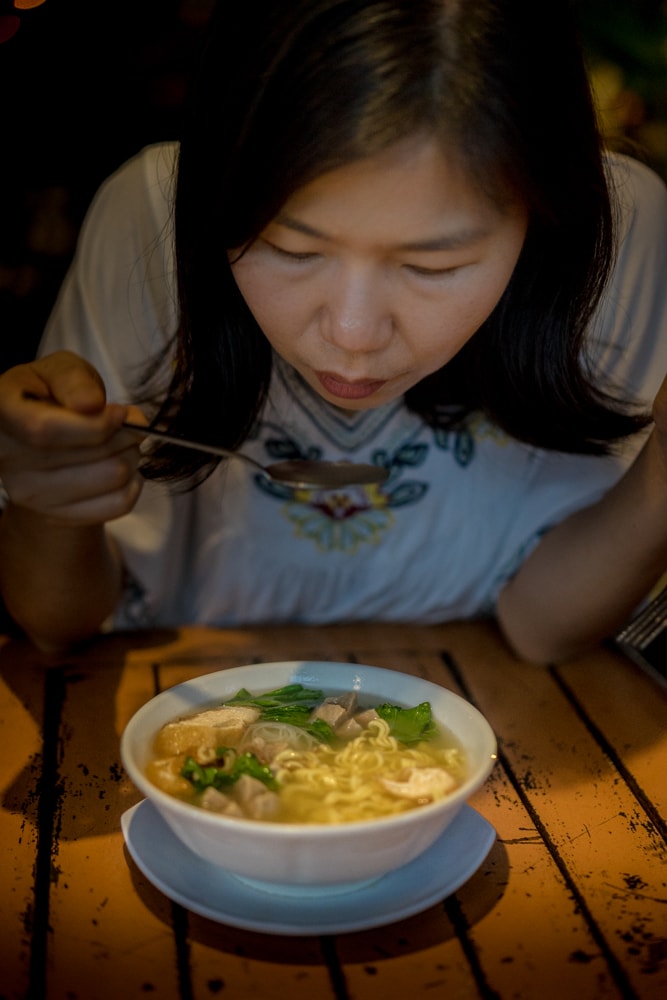
We recommend going to ViaVia for dinner. Half restaurant and bakery, half social enterprise, ViaVia has something special going here.
The menu changes monthly, and all ingredients are organic and prepared without palm oil. The menu features yummy Indonesian and western food, cold beer, strong coffee and exotic smoothies.
Besides dynamite food and vibes, ViaVia offers a few unique tours in and around Jogja. These tours explore interests such as religion, local cuisine, traditional medicine, and contemporary street art, and directly benefit the communities they visit.
Our friendly waitress convinced us that the Culinary Trip was for us, so we booked a foodie trip of Yogyakarta for the following afternoon.
Day 3: Markets, Foodie Tour & Bling Bling Cars
Beringhajo Market

Jogja’s biggest and oldest traditional market has strong ties with the city’s culture and that of Java.
The bright green Pasar Beringharjo building, located on Malioboro street, is a mixture of Javanese and Dutch architecture and bustles with activity all day long, especially in the mornings.
Street food stalls behind and in front of the market are good places to grab a quick bite or a coffee before diving into the market.
You’ll find batik, fabrics, and tourist knick-knacks on the ground floor. This is your place if you still haven’t found that perfect batik shirt or sarong.
Take the stairs up to the second floor for herbs, spices, and fresh produce. We enjoyed this market section the most for the friendly vendors, a great selection of fresh fruit, and the fragrant spices.
The third floor is dedicated to antiques, both real and fake. Here you can browse through records from the fifties and sixties, old typewrites, cameras, coins and furniture, and much more.
Beringharjo Market is open from 08:00-21:00, but the fresh produce section opens as early as 05:00.
Bird Market

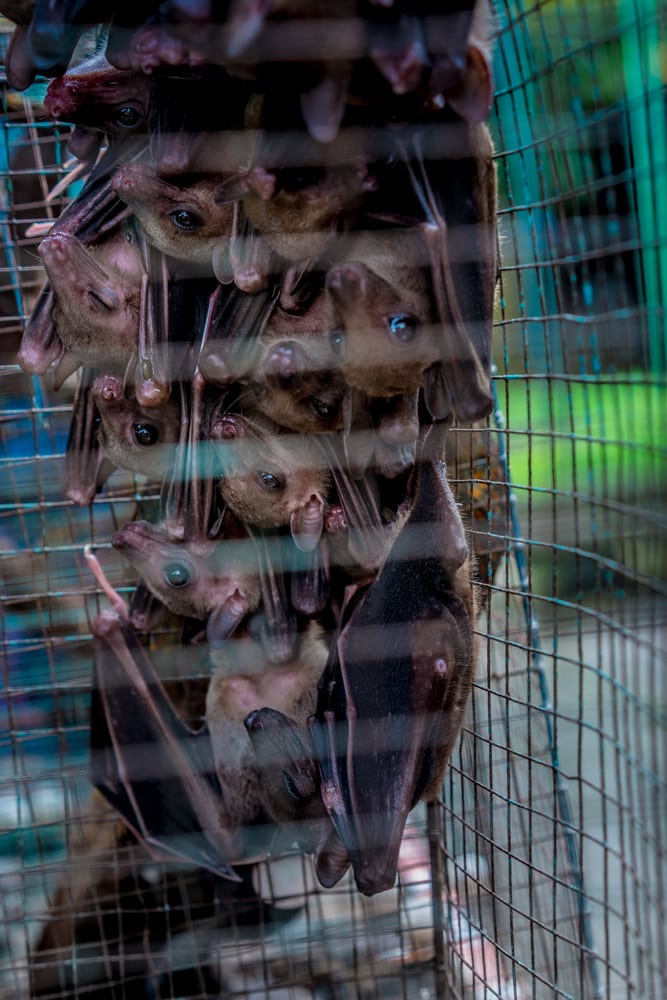

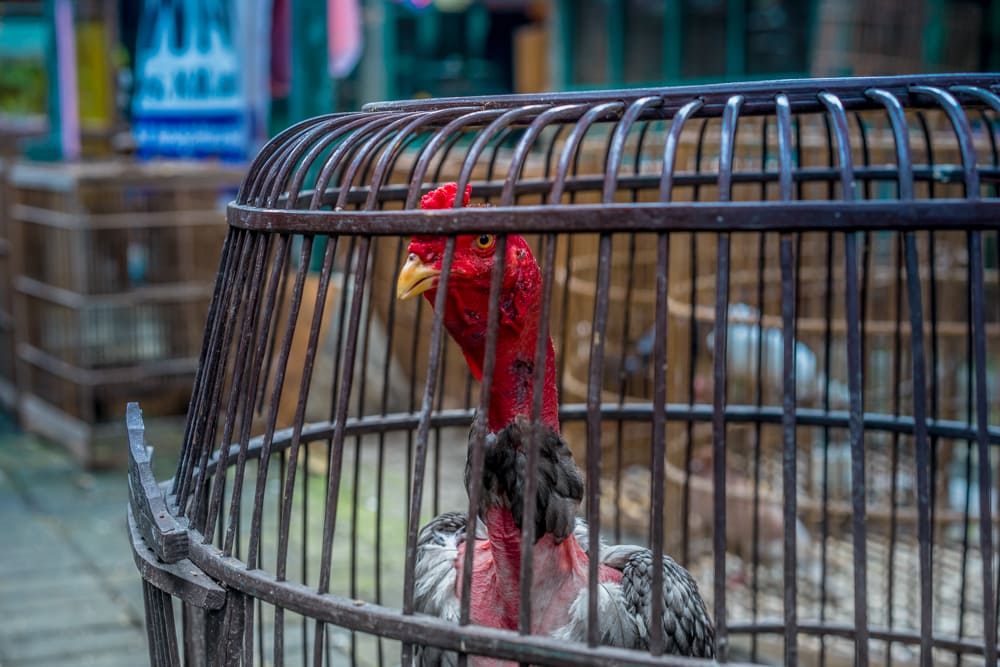
Indonesians love keeping birds as pets, especially in Java. Before visiting the bird market, you’ve probably seen countless bamboo cages with songbirds and finches all over Jogja. Keeping and taking care of birds is an essential part of Jogja culture and something they pride immensely.
A visit to the Bird Market (PASTY Market) in Yogyakarta is a fascinating peek into this aspect of Javanese culture.
The PASTY Market consists of rows and rows of bird cages with exotic songbirds, finches, parrots, eagles, owls, chickens, even bats, monkeys, geckos, frogs, snakes-basically anything that moves.
One section of the market is dedicated to beautiful, handmade bamboo cages.
Visiting this bird market is a bit controversial, especially for animal lovers. Most of these beautiful birds are caught in the wild and hold a genuine conservation threat to wild birds all over Indonesia.
Yogyakarta Foodie Tour

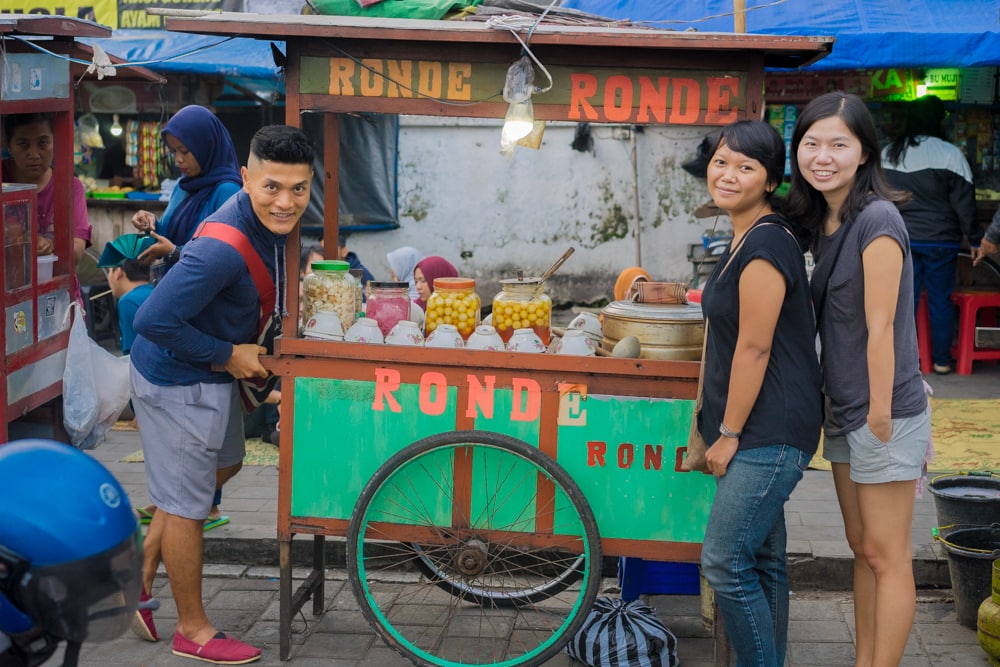

We booked a food tour of Yogyakarta the night before at ViaVia, and this turned out to be the highlight of our Yogyakarta trip. This foodie experience is a must if you’re looking for authentic Jogja culture.
Our two guides, Reeza and Weewee, came to pick us up from our hotel on their scooters, and over the next four hours, they took us around the city to experience the culinary traditions of the Jogja.
Besides trying the different Jogja food, we enjoyed meeting the locals and seeing another aspect of the city, away from the tourist attractions.
First, we stopped at a warung where we made and ate gado-gado, an Indonesian salad of boiled potatoes, vegetables, eggs, tempeh, and peanut sauce.
Our second stop was a bakpia bakery, Jogja’s most famous snack. A team of workers welcomed us and showed us around the bakery where they make these mung bean-filled pastries from scratch and bake them in woodfired ovens. We could try as many as we wanted and also buy some as family gifts at home. Bakpia is the most popular ole-ole (Indonesian word for souvenir) from Yogyakarta.
Gudeg, Jogja’s signature dish, was up next at a warung in the Kraton. The sweet dish of stewed, unripe jackfruit, coconut milk, and beef skin was strange in taste and texture, to be honest.
Next, we hit two different dessert stalls where we stuffed ourselves with local sweets. The colourful kueh, made from tapioca, pandan, and sago, was exquisite.
We ended our food tour at Alun-Alun in front of the Kraton. Here we had ronde, a ginger tea with palm fruit and croutons. By this time, our guides were more like buddies, and we sat on the grass in front of the Royal Palace and chatted like old friends.
Bling Bling Cars

After dark, Alun-Alun Kidul totally transforms as families come out to enjoy Yogyakarta nightlife. A fun thing to do here is a ride on one of the Bling Bling cars – you’ll know when you see them.
These illuminated peddle cars, about the size of Smart Car, are decorated with bright lights, Hello Kitty, Pokemon, Doremon, and other characters and come with an individual sound system pumping out your favourite tunes.
A ride around the square costs RP 40 000 per lap for the whole car.
And that’s the end of our Jogja itinerary. Hope you have a great time in Yogyakarta! Whether you call it Jogja, Jogjakarta, Yogyakarta or Yogya, we are sure you’re gonna love it 😍
How I Shot This Guide
Every photograph in this article was taken with the exact same gear I carry on every journey. It is a setup refined over years on the road to keep travel light without compromising the final image.
- Camera: Sony A7 V
- Lens: Sigma 24-70mm f/2.8 DG DN Art.
- Storage: SanDisk Extreme Portable SSD
- Software: Adobe Lightroom Classic
- My Indonesia travel essential (trust me): Ray-Ban Wayfarer
Where in Indonesia will you go next?
We went all out and treated ourselves to a luxurious visit to Lombok. A short flight via Bali gets you to paradise in no time.
Here are some of our other favourite places in Indonesia:
- Ubud in Bali
- Komodo National Park in Flores
- The Kei Islands in Maluku
- Tana Toraja in Sulawesi
- Amed on the east coast of Bali
- The Banda Islands
- Uluwatu
- 10 Day Itinerary for Bali