
Visiting the Hakka villages and tulou clan houses in Fujian province is an exciting and beautiful journey into rural China. Those wishing to explore China off the beaten path will love exploring the villages of Hakka County.
UNESCO lists these mud castles as prime examples of building tradition, communal living, defence organisation, and living in a harmonious relationship with the environment.
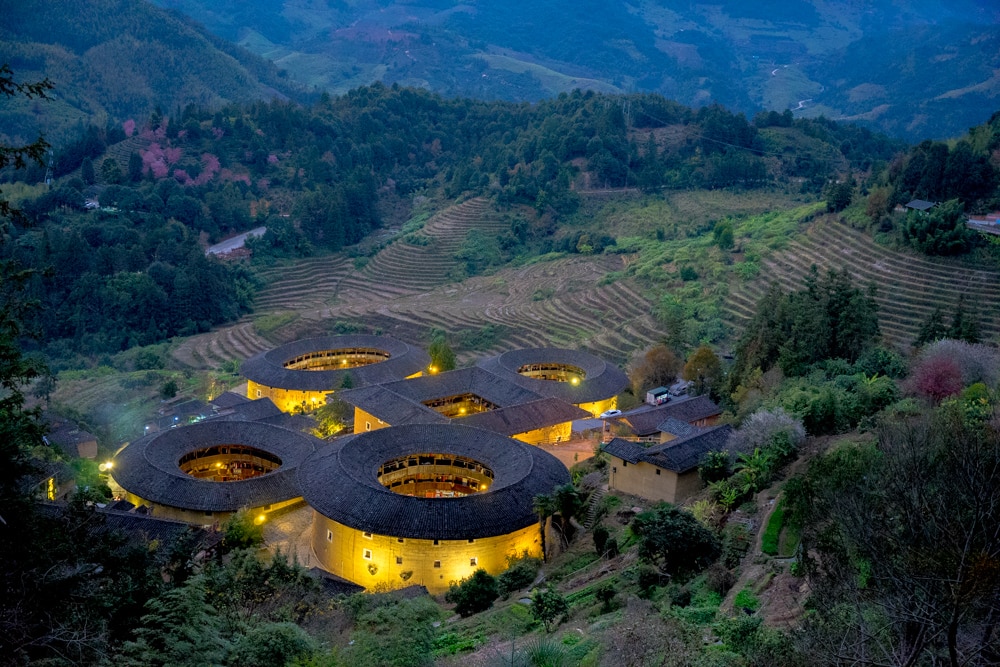
UNESCO status aside, you want to visit these roundhouses because they’re still alive and haven’t been turned into museums. Hakka families still live in these walled compounds and go about their daily lives, cooking, washing, hanging laundry, working the fields, and burning incense in the ancestral halls. They genuinely are Circles of Life.
We recently spent 2 nights in Hakka County exploring the fantastic villages and tulou clusters of Nanjing and Yongding. We encourage anyone who wants to see rural China to come to this unique corner of Fujian province. The Hakka villages must be on any Fujian province itinerary.
In this guide to visiting the Fujian Tulou, we will show you:
- Where are the Hakka Tulou
- Where to stay when visiting the Hakka villages
- One day itinerary touring the tulou villages of Yongding and Nanjing county
- Show you which Hakka villages to visit
Please note: This post may contain affiliate links. This means I may earn a commission if you make a purchase by clicking a link (at no extra cost to you). As an Amazon Associate, I earn from qualifying purchases. Learn more.
Quick Guide to the Fujian Tulou
Visited: December
Suggested time: 2 days
Where to stay: Tianluokeng No.1 Guesthouse
Entrance Fee: Each tulou cluster charges separate entrance fees. See below.
Famous for: Earthen castles, rural villages, Hakka food
Transportation: Hire a driver/guide for the day from your guesthouse
Tip: Respect the privacy of the residents
Unique experience: See the Tianluokeng Tulou Cluster at night
Where are the Hakka Villages in China?
The Hakka people live in southern China, with the majority of the tulou villages located in the provinces of Guangdong, Fujian and Jiangxi.
Of these, the tulou (meaning mud houses) in the rolling mountainous area of Fujian Province are considered the most impressive and easily accessible either on tour or independently from Xiamen.
Several high-speed trains run between Xiamen North railway station and the town of Nanjing. It takes about 40 minutes to reach Nanjing from Xiamen.
A taxi to the Tianluokeng Tulou Cluster from Nanjing station should take about an hour. You can see the schedule and book your Xiamen-Nanjing trains here. Arrange with your guesthouse to send a car to pick you up from the train station.
We came to Nanjing tulou from Wuyishan by direct train instead of transiting in Xiamen. A couple of direct trains run between Nanpingshi and Nanjing daily and take just over 4 hours.
What is a Hakka Walled Village?

When the CIA conducted satellite surveys of the area in the 1960s, they were convinced that these gigantic doughnut-shaped structures were nuclear missile-launching bases. 😂
They are not. The Fujian tulou buildings served as defence structures to keep them safe from outside attacks, not to initiate war.
A Hakka walled village (also called tulou, mud castles, or roundhouses) is a large communal clan house made from rammed earth. Several families, often with the same surname, share a tulou and are still like one big happy family, even in this modern day and age. Each tulou can house between 150 and 800 people.
A tulou is often three to four stories high, with a metre-thick earthen wall forming the outside perimeter. Usually, only one entrance leads into the tulou—these Hakka walled villages were built as defence structures. They can be round, rectangular, square, or oval in shape.
Inside the tulou, each floor serves a different purpose. The windowless ground floor was for keeping livestock, the second floor for storing grains, and the higher stories were (and still are) used as living space. The courtyard contains a well for water and communal space.
Half fortress, half apartment building, these tulou were ultimately built to withstand sieges, and they have indeed stood the test of time. With a well-stocked tulou and access to drinking water, the Hakkas could lock their only door, be safe, and forget about the outside world.
Lucky for us, times have changed, and these days, the Hakka people have thrown open their (only) door to their tulou and welcome visitors to peek around and see this incredible architecture.
Where to Stay When Visiting the Fujian Tulou

Hundreds of tulou clusters are scattered among the Fujian mountains, and the best place to base yourself when visiting them is the Nanjing Tulou cluster. This area has good accommodation, the highest concentration of Hakka tulou buildings (around 15 000) and is most convenient for independent exploration.
While it is possible to stay inside some of the tulou, keep in mind that most tulou don’t have modern plumbing. This means that you will have to use the public bathrooms located outside the tulou, along with the rest of the village.
We decided to stay in the Tianluokeng Tulou Cluster (田螺坑土楼) for two nights, and we just loved staying in this picturesque village. Staying in Tianluokeng allows you to see the village lit up at night from the viewpoint just behind our guesthouse.
Tianluokeng No.1 Guesthouse is located right inside the Hakka village, metres away from the famous tulou. The ensuite room was comfy, clean, and came with piping hot water in the shower.
The friendly family speaks some English, serves tasty Hakka food and helped us to organise transportation to and from the station in Nanjing. The same driver helped us plan and took us on our tour of different tulou clusters the next day.
Send a message after making a reservation to arrange pickup from the train station.
One Day Fujian Tulou Tour Itinerary

After arrival at our guesthouse, we had a traditional Hakka dinner and then sat down with our driver and plotted our one-day tour of the tulou for the next day.
We left Tianluokeng around 9:30 and were back just after 16:30.
Our one day Hakka village & tulou tour itinerary:
- Leave Tianluokeng after breakfast
- Yongding Tulou
- Yunshuiyao Scenic Area
- Taxia Village
- Yuchang Tulou
- Return to Tianluokeng
Which Hakka Villages & Fujian Tulou to Visit?
Tianluokeng Tulou Cluster
(田螺坑土楼)


Nicknamed Four Dishes and One Soup, this is one of Fujian’s most iconic tulou villages and one of the most popular with visitors.
Tianluokeng consists of five enormous earthen castles, a rectangular one surrounded by four round ones. The hill behind the village has an observation deck (free entrance) from where you get to see the four dishes and soup nestled between the terraced rice paddies and banana trees.
Go up to the observation deck for sunset and see the village light up. It is gorgeous.
We found Tianluokeng the most authentic of the Hakka villages, perhaps because we stayed there. Strolling around the village and peeking into the tulou we saw residents drying vegetables, curing sausages and doing whatever you’d do in a mud castle.
There are a few small restaurants where you can grab a bite to eat, as well as a couple of shops selling snacks, fruit, and vegetables.
- Entrance fee: RMB 90
- Includes: Tianluokeng, Taxia Village, Yuchang Tulou
- Suggested Time: 1.5 – 2 hours
Yongding Tulou Cluster
Visitors love Yongding because it packs a punch. Of the 46 UNESCO-inscribed tulou, 23 are in Yongding County. Some will also claim that the best tulou buildings are in Yongding.
Of them all, King Tulou is the crown jewel. Movie buffs will recognise King Tulou from the Disney movie Mulan.
Yongding County has thousands of tulou scattered across clusters such as Hongkeng, Gaobei, Chuxi, and Nanxi. Our driver/guide recommended visiting the Gaobei Tulou cluster only, as it has the best tulou in Yongding County.
Chengqi Tulou (承启楼)


Known as King Tulou, the Chengqi tulou is an imposing round earthen building with over 400 rooms. It’s enormous, with the courtyard having a diameter of 73m.
Inside the tulou, three concentric rings of buildings surround the ancestral hall in the centre. This makes King Tulou feel almost maze-like. While this is indeed quite spectacular, it’s difficult to see the beautiful layout of the tulou, as visitors are not allowed to go to the upper floors of the tulou building.


Luckily our guide told us that there was a photographer in a room on the second floor that would take a nice picture of us for RMB 20. Within minutes we had our laminated A4 photo of us standing inside the concentric circles of the King Tulou.
Our driver helped us get the photo file sent to my WeChat because, you know, it’s the 21st century and who still keeps laminated photos and not on their phone?
The Chengqi tulou was bustling with activity on the day when we visited. The tulou residents were preparing for a funeral, and hundreds of Hakkas from the surrounding villages came to help out
Qiaofu Building (侨福楼)


The small round tulou building next to the King Tulou is the Qiaofu building. Qiao refers to overseas Chinese, while Fu means good fortune.
This tulou is also known as the Doctor Tulou, as 11 of its residents, including a woman, graduated as doctors. Photos of the doctors are proudly displayed at the altar at the back of the tulou.
Shize Building (世泽楼)

Two square tulou buildings stand next to King Tulou. We checked out the Shize tulou, right next to the round King Tulou.
It is possible to go to the upper floors in this tulou. We paid RMB 5 to go up to the third floor to take pictures.
- Entrance fee: RMB 50
- Suggested Time: 1 -1.5 hours
Yunshuiyao Village
(云水谣)


Don’t miss this enchanting village! You will see more UNESCO-listed tulou and the stunning Yunshuiyao village, with its gigantic banyan trees and riverside setting. The combination of the tulou (53 in total) and quaint Yunshuiyao is rural China at its most magical.
Unless you’re doing a dissertation on the architecture of the Hakka people, limit yourself to seeing the two best tulou: Huaiyuan and Hegui tulou.
When you reach Yunshuiyao, it should be lunchtime, so ask your driver to take you to his favourite place. Restaurants are likely to have a picture menu.
After lunch, we suggest you see the Huaiyuan Tulou and then walk along the river through Yunshuiyao village to the Hegui Tulou. Arrange with your driver to meet you at Hegui Tulou after about two hours.
Huaiyuan Tulou (怀远楼)


This large, round earthen building, constructed in 1905 during the Qing Dynasty, is well preserved and has 136 rooms inside.
At the courtyard’s centre, you’ll find an ancestral hall surrounded by two concentric rings of buildings. The outer ring was used as a school, the only such tulou. Even under siege (or lockdown), these Hakka children had to sit their little asses down and study their ABCs.
You can pay RMB 5 to one of the residents who will let you go up to the fourth floor. This is the best photo spot, as you will have a great view of the tulou’s design.

Some interesting earthen buildings surround Huaiyuan, featuring unique designs such as stars or calligraphy. We suspect that they will be same-same on the inside, so maybe just take pictures of the exteriors, as their entrance fees are not included in your ticket. (RMB 10 extra).
Locals sell sweet passion fruit juice and red bananas in this area, too. Give them a try; they’re delicious, and you probably need the energy.
The Banyan Trees of Yunshuiyao Ancient Village


Originally called Changjiao, the village is now affectionately known as Yunshuiyao, which means A Song of the Clouds and Waters. This ancient village was the shooting location of the Chinese blockbuster called Yunshuiyao, which won the Best Film Award at the 2007 Golden Rooster Awards.
Following the film’s fame, the village was promptly renamed.
A cobbled footpath connects Huaiyuan Tulou to Hegui Tulou, with beautiful Yunshuiyao in the middle. The path takes you past traditional houses, waterwheels and stepping stones crossing the river.
Along the way, you’ll pass thirteen enormous banyan trees on the riverbank. Like ancient green umbrellas, these trees are hundreds of years old and truly magnificent.
Hegui Tulou (和贵楼)


The rectangular Hegui tulou is unique in many ways. Standing five stories high at a height of 21 metres, it is the tallest of all the UNESCO tulou. Built on swampland, it’s a wonder that this giant is still standing after almost 300 years.
Nicknamed Noah’s Ark, we thought it was because of its shape and size. But no, it’s called Noah’s Ark because the marsh it sits in swells during the rainy season, and water seeps into the tulou courtyard.
Considering the marsh and the size of the tulou, it’s a miracle that the Hegui building is still standing today.
The outer wall is almost 1.5 meters thick at its base but gradually tapers out to just 60 cm on the 5th floor to prevent it from being top-heavy.
Inside the courtyard, you’ll see two wells containing different water, even though they are just metres apart. One well has sweet, clear water, and the other murky. They are called the Ying Yang wells for apparent reason.
Taxia Village
(塔下村)


Less than 10 km from Tianluokeng, beautiful Taixa village sits on the banks of a small river. Almost everyone in this village shares the surname Zhang.
The Zhangs are hardworking people. In the past, many of them have worked overseas, bringing back a lot of money to Taixa village. Many of them have also opened hotels and guesthouses.
By the time we reached Taixa, we were pretty much tulou-ed out. We were ready to push on to our guesthouse, but the driver insisted we make a quick stop here. I’m glad he convinced us.
The Zhang Family’s Ancestral Hall ( or Deyuan Hall 德远堂) behind the village is a nice distraction from all the tulous. This small temple is beautiful, and the reflections in the moon pond, totem poles, and ornate dragons on the roofs make lovely photos.
Twenty-four stone totem poles stand next to the half-moon pond. Each time one of the Zhangs achieves something noteworthy, a new pole is added.
- Entrance fee: Included with Tianluokeng (RMB 90)
- Suggested Time: 30 minutes
Yuchang Tulou
(裕昌楼)


The last stop on our DIY tulou tour is the Yuchang building, about halfway between Taixa village and Tianluokeng.
The Yuachang, dating from 1308, is another gigantic, round tulou. The courtyard is empty except for a single small building at the centre, which is nice, as you can capture the sense of scale in your photos.
Instead of the entire tulou sharing a communal well in the courtyard, each household has access to its own well in its ground-floor kitchens.
Yuchang tulou tilts inward at a 15-degree angle, giving it the nickname of…you guessed it… China’s Leaning Tower of Pisa.
- Entrance fee: Included with Tianluokeng (RMB 90)
- Suggested Time: 30 minutes or less
Also read:
➜ 10 of the Best Books to Read Before Travelling to China
Visiting the Hakka Walled Villages and Tulou:
Any Questions?
Visiting the Tulou villages independently is a wonderful (but busy) day out. It is much more relaxing than travelling to and from Xiamen on a day tour. We hope you can go and see them.
If you have any questions, drop us a message below, and we’ll try our best to help.
How I Shot This Guide
Every photograph in this article was taken with the exact same gear I carry on every journey. It is a setup refined over years on the road to keep travel light without compromising the final image.
- Camera: Sony A7 V
- Lens: Sigma 24-70mm f/2.8 DG DN Art.
- Storage: SanDisk Extreme Portable SSD
- Software: Adobe Lightroom Classic
- Outerwear: My North Face Canyonland jacket was lightweight and warm, perfect for travelling in Fujian in December
First of all, thanks for all information and detail. It’s beneficial and exciting.
I will be traveling next week in Xiamen, and I plan to go for one day to visit Huaiyuan and Hegui tulou.
Do you have any recommendations for a driver (I will stay in Xiamen).
I look forward to hearing from you soon.
Michel
Hi Michel,
Huaiyuan and Hegui tulou are great choices, we liked that area a lot.
We stayed in Tiangluokeng and our guesthouse helped to organize a driver for us.
Coming from Xiamen, you have a few options:
1: Get a driver or join a day tour (look on Viator for this)
2: Ask your hotel in Xiamen to put you in touch with a driver for the day.
3: Get the train to Nanjing(Fujian) and get a taxi from there. Or download DiDi (Chinese Uber) and DiDi from the station to the tulou.
Enjoy your trip!
Hello, thank you for helping me organizing my trip to Fujian!
How can we pay in the villages? Can we use only cash?
Do you know what would be the price for a car transfert from Xiamen to Tianluokeng ?
Thank you in advance!
Hi Sarah,
You can pay with cash (or WeChat or Alipay if you have that connected to your bank and on your phone) in the villages. If not- cash is king. Credit or debit cards will be useless.
A private car between Xiamen and the tulous should be around $100 one way.
We suggest getting the train to Nanjing and then a taxi from there to save some money.
Wish you a great trip in Fujian 🙂
Thanks for all the info. Do you have the wechat ID for the No1 guesthouse? We have booked but need to contact them. Thanks.
Hi Anne,
We booked on Trip(dot)com and got their phone number from there to add on WeChat. Give that a try. The number I have for them is :+86 13023958315. We arranged with them for a car to come pick us up at Nanjing train station
Hello,
May I know what is the price for a private driver/guide the whole day?
Thank you very much!
Dear Jin and De Wet,
Thank you very much for all the information and the wonderful pictures. I would love to follow your footsteps this year December. Do you mind telling me how much you payed for the car/ driver, as I will be traveling on my own. Thank you very much !
Hello Betina,
Getting a car and driver is definitely the best way to see the villages.
We paid RMB 400 for our trip. This was a few years ago, so it could be a bit more expensive now. Ask your guest house to recommend a driver.
Enjoy your trip
Dear De Wet and Jin,
thank you gor getting back to me so fast. Even if it is now a little bit more expensive, it is a reasonable price and I love being independent. Thanks again for sharing your experiences
Betina 🤗
I love your photos. Do you use a SLR camera or a camera phone? If SLR, what lensea do you use?
Thanks
Hello Yan,
Thank you for the compliment.
I’m using a Sony A7 (first gen)- it’s old but I love it and will use it until it falls apart.
The lens for all these photos is the Sigma 24-70mm f/2.8 DG DN. It’s a magnificent lens and stays on my camera 99% of the time.
Dear De Wet and Jin
Thank you very much for the very useful guide.
Dear De Wet and Jin,
Love your write up and photos. It really helps to plan my trip.
I am travelling on my own in August. I would like to engage a private car & guide. Appreciate if you share the contact number. Thank you so much.
Hi Su Anne,
I’m glad to hear you found this post helpful. We did this trip a few years ago and don’t have the driver’s details anymore.
The best is to either arrange with your guesthouse once you arrive, or send a message to your guesthouse after booking. That’s what we did (sent message to hotel after booking, the driver came to pick us up at the train station, took us to the guesthouse, and then we arranged with that same driver for a full day tour the next day).
Hope you have a good trip.