
Wuyishan (the Wuyi Mountains) is a spectacular natural wonderland in China’s southeastern Fujian province. Well off the trodden path to most Western visitors, the Wuyi Mountains (武夷山) will wow those who come with magnificent dome-shaped mountains, tranquil hiking trails, bamboo rafting on crystal clear rivers and, of course, a freeflow of Wuyi Oolong tea.
Wuyishan has been a UNESCO World Heritage Site since 1999 for its outstanding biodiversity and cultural significance. The Wuyi Mountains are significant to Confucianism, Taoism, and Buddhism, which is evident in the numerous monasteries and temples hidden in the valleys and on the mountains.

Just like a good cup of tea, Wuiyshan brews a magic visitor’s experience with serene mountain scenes, lush tea gardens, ancient temples and tea culture that left us feeling refreshed. It is the ultimate zen adventure. We will definitely be back again.
If all this zen talk hasn’t got you packing your bags already, here is our take on the best things to do in Wuyishan. We can also call it the Wuyishan Guide to Instant Enlightenment if you prefer.
Please note: This post may contain affiliate links. This means I may earn a commission if you make a purchase by clicking a link (at no extra cost to you). As an Amazon Associate, I earn from qualifying purchases. Learn more.
Quick Guide to the Wuyi Mountains, China
Visited: December
Suggested time: Three days minimum
Where we stayed: Ancient Street No 3 Tea Hotel
Entrance Fee: RMB 124 for three days
Famous for: The best Oolong, Rock Tea & Da Hong Pao on earth, excellent hiking
Transportation: Wuyishan has an airport, but flying to Xiamen and getting a train from there is much cheaper. See the bottom of the post for instructions on how to get to Wuyishan. Shuttles inside the park are included in the entrance fee
Tip: Enjoy a foot massage after a day of hiking
Unique experience: Sit down for a tea tasting at one of the many tea shops. Don’t miss the Impression Da Hong Pao show.
Things to Do in the Wuyi Mountains


Wuyi Mountains National Park protects one of the world’s most significant subtropical forests and the largest intact forest in China.
Wuyishan is known as three by three, six by six, seventy-two, and ninety-nine. These digits are not only of great importance in Taoism, Buddhism and Neo-Confucianism but also reflect the natural beauty of the park.
Three by three refers to the Nine-Bend stream that snakes through the mountains and is the soul of Wuyishan.
Six by six refers to the 36 peaks rising above the river.
Seventy-two represents 72 caves, while ninety-nine refers to 99 cliffs.
Between these numbers, you’ll find tranquil, mossy hiking trails, panoramic views, ancient temples, hundreds of tea gardens and zen to keep you occupied for days.
Here is our list of attractions and activities to show you the best things to do in the Wuyi Mountains.
Climb Tianyou Peak 天游峰
(Heaven Tour Peak)


There are enough mountains and peaks to scale to keep you hiking for weeks. So if you climb only one, let it be Tianyou Peak. Unless you’re a Himalayan mountain yak, then climb and clamber to your heart’s delight.
Tianyou Peak(天游峰), or Heaven Tour Peak, is the poster child of the Wuyishan and offers a stupendous view of the area. This peak rises almost vertically above the 5th and 6th bend of the Nine-Bend River.
To reach the summit, you will climb 848 steep stone steps carved into the sheer cliffside. It is a spectacular climb, and the views keep getting better and better.
The walk from the Tianyou Peak Shuttle bus stop takes about 20 minutes to the base of the peak. You’ll follow the river and pass a few temples along the way.


Just before reaching the steps leading up Tianyou Peak, look out for a mountain with a massive crack in it (on the right). Go check out that crack – there is a narrow set of steps in the crevice leading up to a small pagoda with sweeping views.
Go Bamboo Rafting on the Nine-Bend Stream


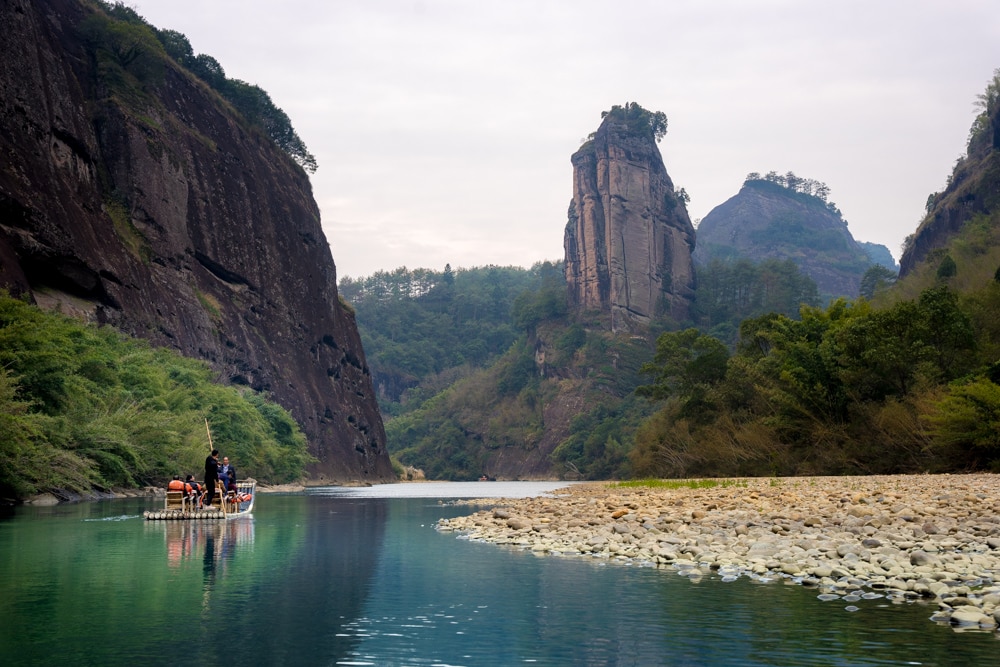

Meandering through the Wuyi Mountains, the jade coloured Nine-Bend River cuts the landscape into deep gorges, pebble beaches and vertical cliffs rising straight from the river.
The best (and most relaxing) way to see the beauty of Wyuishan is from a bamboo raft floating down the Nine-Bend Stream.
The rafting is not included in the Wuyishan National Park entrance fee. You can pay (RMB 130 per person) and choose a departure time for your rafting trip at the entrance when you pay your admission.
A shuttle bus to the base of Huang Guang Peak will take you to the bamboo raft wharf (九曲溪竹筏). There are a few small restaurants and vendors selling fish food and waterproof sleeves for your shoes (not needed!) at the wharf.
Rafts depart from the ninth bend and take about 2 hours to float downriver to the first bend. Rafts are fitted with eight chairs, so smaller groups will be teamed with other passengers.
On the front and back, two raftsmen will guide the raft along the nine-odd kilometre journey. Along the way, they will point out the bends and recite poems about the landmarks.
Bright red inscriptions etched into the cliffs mark each bend. Over 400 hundred of the engravings make up what is referred to as the Caligraphy Garden.
Was it not for the incredible scenery, fish jumping out of the water next to the raft or a few exciting rapids, the rhythm and sound of the river could easily lull you to sleep.
Just like in Yangshuo, the scenes from the bamboo raft are straight from a Chinese watercolour painting.
Squeeze Through the Thread of Sky (线天)


One of the weirdest landmarks in the Wuyi Mountains is a fissure cave called “A Thread of Sky“. It is an enormous crack that had split a mountain in two.
Visitors can follow a path and walk through this giant crack. Squeezed between 2 sheer vertical rockfaces, the only light you’ll see will be the Thread of Sky peeking into the narrow gap above you.
The narrowest section of the Thread in the Sky is a mere 35 cm wide, so better suck in than belly and squeeze through! Between a rock and a hard place flashed through my mind as I scraped through.
A sign directs visitors to a Thread in the Sky left and right sections at the entrance. We took a right, and it was spectacular. I’m sure the left will be the same.
If you have claustrophobia, maybe wait outside or only explore the cave entrance.
Hike the Rock Tea Trail


The Rock Tea Trail, a stunning 2.8 km hike in the Da Hong Pao area, will reward you with some of the best scenery in the Wuyi Mountains. On this hike, you’ll get to see the Da Hong Pao Tea Garden, Huiyuan temple and the Water Curtain Cave. While it’s only 2.8 km, put aside at least half a day to enjoy the beauty, fresh air and tea stops along the way.
Walking from the Da Hong Pao shuttle bus stop, hikers will be in narrow valleys filled with tea gardens flanked by domed cliffs in no time. And these are not just any tea gardens—these tea gardens are Da Hong Pao, or Big Red Robe tea, the most sought-after and expensive tea on earth.
Da Hong Pao Tea Garden


The first stop on the Rock Tea Trail is the Da Hong Pao tea garden. Look out for the Chinese characters 袍红大 on the cliff on the right. Next to these characters, you’ll see the original six (female) Da Hong Pao trees. They are over 350 years old. Tea from these six trees can fetch thousands of dollars per gram. They are also insured for millions of dollars.
As with champagne, only tea from this garden can rightfully be classified as the real McCoy. However, unless you’re a tea connoisseur, tea from a garden a hundred meters away will taste the same and save you a lot of money.
There is a lovely teashop next to the garden where you can indulge in Da Hong Pao, right in its natural habitat. The price was a bit steep for us, so we went with an excellent (generic) Da Hong Pao ice cream a milk tea instead.
Huiyuan Temple (天游峰)


The small and simple temple, also known as Fuhua Temple, dates from the Song Dynasty. Nestled between the mountains and tea gardens, the Huiyaun Temple is a quiet spot where you can relax, drink tea, and enjoy the simple life.
A small building behind the temple houses a shrine, and we saw some monks and locals having tea. We asked if we could buy some tea to drink, and a friendly monk told us to make a donation to the temple instead of paying for the tea. He took us to the shrine, where we scanned a QR code and donated a few RMB to the temple.
After that, we sat on the porch, brewed a few pots of delicious rock tea, played with the monk’s puppies, and life was pretty perfect.
Water Curtain Cave (水帘洞)


One of the 72 caves of the Wuyi Mountains, the Water Curtain is yet another spectacular landmark. A red cliff rises about a hundred meters straight up, with a small waterfall tumbling over it like a hanging curtain. Beneath the water curtain is a small, wooden temple dedicated to Zhu, the master of Neo-Confucianism.
More waterfall than a cave, the Water Curtain was a mere drip when we visited in December, which is the dry season. Still, the setting is majestic and well worth a visit during any time of year.
The Rock Tea Trail wows with views right until the end. It’s a lovely walk from the Water Curtain Cave to the shuttle bus stop.
Watch the Impression DaHongPao Show


If there is one thing that China knows how to pull off, it’s the performing arts. The Impression DaHongPao Show is a nightly event and man – WHAT A SPECTACLE IT IS!
Do not miss this extravaganza. I repeat: DO NOT MISS THE IMPRESSION DAHONGPAO SHOW!
Impression DaHongPao, or The Story of Tea, is a musical extravaganza on a scale and grandeur that only China can pull off. Hundreds of performers dressed in exquisite costumes sing and dance in an equally impressive set.
Even the Wuyi Mountains are lit up during certain parts of the show. The set extends to the river between the stage and the mountains. Remind yourself to close your mouth and keep it from hanging open.
Now get this: the audience rotates 360 degrees around the set! Just like the boatmen rafting you on the Nine-river bend, performers punt and spin you from one magical scene to the next during the show. It’s pure brilliance.
Book your tickets in advance to avoid disappointment. The show is very popular, and everyone wants to see it.
Drown in Wuyishan Oolong Tea


The Wuyi Mountains are any tea lover’s paradise. As the birthplace of Oolong tea, there are hundreds of varieties to choose from.
Each valley, canyon or cliffside has its unique micro-climate, soil and sunshine. The hundreds of tea gardens scattered between these cliffs each produce an exceptional cup of tea, unique in taste, fragrance and character.
Pop into any of the hundreds (if not thousands) of tea houses in town for a tea tasting. The teahouse owner will brew you pot after pot of rock tea until you have found the one you like. Plan to spend at least an hour sipping, smelling and slurping Wuyishan’s famous rock tea.
Eat Da Hong Pao Ice Cream

Don’t just drink tea; you should also try the delicious Da Hong Pao ice cream. Like a good cup of Da Hong Pao, this velvety tea ice cream will send you straight to a zen state of mind with cinnamon, vanilla, caramel, tobacco, charcoal, sandalwood and whiskey notes.
I know it’s hard, but you should probably try and limit your Da Hong Pao ice cream intake to two per day 😂 .
Good luck with that.
Tuck into Fujian Cuisine

Fujianese, or Min Cuisine, is known for its soft and tender cooking style that’s not greasy, with light seasoning to retain the flavour of the original ingredients. Light and fresh dishes are often braised, boiled or steamed, and as a coastal province, seafood is usually the star of the meal.
However, in inland Fujian province, carp replaces sea fish, and as to be expected of China’s tea capital, dishes are often infused with tea leaves. You should also try the fantastic bamboo shoots and wild mushrooms of Fujian province.
Our favourite restaurant in Wuyishan is Chui Yan Restaurant (炊烟·山房菜) located right next to our hotel and comes highly recommended. The tea leaf chicken dish was delish, as were the bamboo shoots.
For spicy Chuan Chuan (skewers in hotpot), try this restaurant 邑元老串串(三姑度假区店). It’s self-help, and you just add meat and veggies to your basket from the freezer yourself and boil it in the hotpot. It’s damn delicious and easy.
Head over to 炫鱼坊 for incredible grilled fish that’s boiled in a broth of your choice. It might sound strange boiling grilled fish, but believe me, IT’S GOOD!
Also read
➜ 10 of the Best Books to Read Before Travelling to China
Where to Stay in the Wuyi Mountains

We stayed at the stunning Wuyishan Ancient Street Tea Hotel, and we just loved it.
The spacious room has a large window looking out towards the Wuyi Mountains. In front of the window is a large desk set up as a tea station where you can brew your own tea and have yourself a tea ceremony while taking in the view.
It also has a large bathtub and a separate shower.
Downstairs, you’ll find friendly staff always willing to help, and a tea shop where you can try many rock teas before buying. At night, complimentary teas or fruit soups are offered in the lobby.
How to Get to the Wuyi Mountains
Wuyishan Airport is about 12 km outside town. There are regular flights to Beijing, Shanghai, Guangzhou, and Xiamen. It’s usually cheaper to fly to Xiamen and then catch a train from there.
Train: Many high-speed trains run daily between Xiamen and Wuyishan, taking about 3 hours. Nanping City Railway Station and Wuyishan North Railway Station serve the Wuyi Mountains.
See train schedules and prices here.
Wuyishan North Station is the closest to town and should be your first option. This station is still about 30 minutes by taxi away from Wuyishan town.
Nanping City Station: We got a train from here directly to the Fujian Toulou area instead of going back via Xiamen. A Didi from Wuyishan to this station takes about 30 minutes.
Beware: Don’t confuse Nanping City Station with Nanping Station, which is two hours away by taxi!
Wuyi Mountains: Questions?
We are sure that you’ll love the Wuyi Mountains as much as we did. If you have any questions, shoot us a comment below and we’ll try our best to help.
Hello,
Thank you very much for these very interesting informations.
Photographer, I want to photograph the tea harvest. What is the best time? April ? May ?
Thank you for your reply.
Alexis
Hi Duclos,
We went in December. The first flush is from late February and the harvest lasts until end of April usually
Xìè xie!
Bu keqi, Jackie
Hello. From Nanpingshi Station, do I just tell the taxi driver that I would like to go to Wuyi Mountain and they would know where to drop me off?
Hi Emily,
If you have the Didi ride share app you can put in the address. That will be the most convenient. Otherwise tell the driver Wuyishan (武夷山) – show him the Chinese characters. This should get you to the town at the entrance of the area.
when you visit Fujian Tulou, it is easy to get DIDI to visit Tulou form Train station?
Hi YK,
I’m not too sure about the Didi situation at the train station. I think it shouldn’t be a problem, but like I said we didn’t use Didi. We arranged with our hotel to send a driver to pick us up. Also note that the train station (Nanping) is still more than an hour’s drive to the tulou clusters.
If you have DiDi already on your phone, maybe check out the route. I just went on DiDi and saw there are cars available right at Nanping Station (don’t know if they will go long distance though)